24 November 2021. A virtual dialogue was organized by the Soils4Africa project [https://www.soils4africa-h2020.eu ] in close collaboration with FARA. The Soils4Africa project, aims to provide an open-access soil information system (SIS) with a set of key indicators and underpinning data, accompanied with a methodology for repeated soil monitoring across the continent.
It was a side event to the 17th Comprehensive Africa Agricultural Development Program – Partnership Platform (CAADP-PP).
This webinar provided an opportunity to engage with high-level stakeholders from Europe and Africa and advance the dialogue on strategies to embed the SIS into the knowledge framework for the sustainable intensification of African agriculture, and the delivery of CAADP goals. It also facilitated stakeholders’ understanding of the process, methodology, and relative utility of the SIS. The event was an opportunity to seek the endorsement of other continental organization for continuous development and use of the SIS beyond the life of the Soils4Africa project.
The SIS will become part of the knowledge and information system of the AU-EU research and innovation partnership on food and nutrition security, and sustainable agriculture, and will be hosted by an African institution. It is the ambition of the project to provide a system beyond the state-of-the-art methods currently employed in the agricultural sector in Africa.
The envisaged system will support the generation and application of agriculture innovations and ultimately help to boost sustainable intensification.
The Soils4Africa consortium consists of 17 organizations in Africa and Europe working together and funded under the Horizon 2020 program of the European Union.
22-26 November 2021. The theme chosen for the 17th CAADP Partnership Platform was centered on “Ending hunger in Africa by 2025 through resilient food systems”, to take advantage of renewed momentum that has been created by the UN Food System Summit, at a moment when the continent is halfway through the Malabo Declaration timeframe.
The Malabo Policy Learning Event (MAPLE) is an annual policy dialogue convened by the Africa Union and its partners designed to bring together technical networks, country-level policy practitioners and leaders to discuss important agricultural policy topics, share learning and generate actions that can drive the Malabo Agenda.
Objectives of the MAPLE:
To share lessons and experiences on the review, design, and implementation of Malabo-compliant National Agricultural Investment Plans (NAIPS).
To highlight how inclusion and resilience have and can been integrated in Food Security programming in the context of Malabo implementation.
To review and learn from different policy implementation approaches and tools
To identify key actions that if implemented at National, Regional and Continental levels, will accelerate the implementation of the CAADP agenda
Sessions:
SESSION 1: Opening and Scene Setting
SESSION 2: Diversity, Equity and Inclusion in African Food Policy Systems
SESSION 3: Design and Implementation of Malabo-Compliant NAIPS
Ousmane Badiane (Akademiya2063): Revisiting NAIPS as a tool for managing national implementation – what is the evidence that this works and how can countries better supported to develop good National Agricultural Investment Plans (NAIPs)? How BR review has informed NAIP formulation and implementation?
SESSION 4: Learning sessions on policy implementation approaches and tools
The two previous Biannual Review reporting cycles had shown that pace at which implementation of CAADP was taking on the ground was not good enough to lead to the intended goals.
More specific to this year’s theme of the Partnership Platform, these same reports have revealed
that Africa, as a whole, is not on track towards meeting the ending hunger by 2035 commitment.
Besides this worrying underperformance, the COVID-19 global pandemic has dealt the efforts by the continent a serious blow for close to two years now.
Against this backdrop, the 17th CAADP PP served as an opportunity for main constituencies involved in supporting agriculture transformation on the continent to reflect on the main course of actions to bring Africa back on track towards ending hunger through resilient food system by 2025.
The theme of the 17th CAADP was divided into 3 sub-themes as follows:
Strengthening systemic capacity to “build back better”;
Nutrition and Food Safety;
Agri-food trade;
Science and innovation.
The 17th CAADP PP had three specific objectives:
Assess the status of the implementation of the Malabo commitments on ending hunger in Africa, based on the findings of the 2nd CAADP biennial review report and various
evidence-based analysis and consolidate policy actions to fast-track the implementation.
Engage participants on the Africa common position on the food systems and its meaning and implications for the Malabo Declaration commitments, goals, and targets.
Catalyse contributions from the parties involved to chart a realistic roadmap for the remainder of the Malabo journey towards achieving the ending hunger commitment by
2025.
24/11 SESSION 1: Strengthening systemic capacity to help “build back better”
24/11 SESSION 2: Nutrition and Food Safety
25/11 Pan -African Network for Economic Analysis of Policies (PANAP) side event parallel
PANAP is a network among academic/research and institutional partners collaborating with the European Commission - JRC in developing research on agricultural economics and policy issues with a focus on Africa. PANAP aims to strengthen the liaison between researchers/scientists and policymakers in Africa, and to stimulate their cooperation on selected topics linked to policy priorities that reinforce the stability of agriculture and food sectors in Africa. It will also help achieve the sustainability of the agri-food sectors to enhance food and nutrition security in alignment with the Malabo Declaration Commitment 3 on ending hunger in Africa by 2025 and Sustainable Development Goal 2 (SDG2 - Zero Hunger).
Welcome remarks: H.E Amb. Josefa Sacko -The Commissioner for Agriculture, Rural Development, Blue Economy and Sustainable Environment, AUC
Mr. Stanlake Samkange, Chair, CAADP Development Partner Coordination Group
Dr. Ibrahim Assane Mayaki - Chief Executive Officer, AUDA-NEPAD
Hon. Angela Thoko Didiza, Chair of the Bureau of the 3rd AU STC on Agriculture, Rural Development, Water and Environment, and Minister of Agriculture, Land Reform and Rural Development, South Africa
Dr Agnes Kalibata, President of AGRA and UNFSS Special Envoy: “From UNFSS to Actions – what is needed to strengthen institutions and increase investments to accelerate CAADP implementation?”
Feedback from Technical Sessions 30mn
Feedback from MAPLE 10mn
26/11 High-Level Ministerial Forum (HLMF)
Session Moderator: Hon. Angela Thoko Didiza
Commissioner Agriculture ECOWAS
Minister of Agriculture Uganda (only country on track to ending hunger in the 2nd BR report)
Minister of Agriculture Morocco
Minister of Agriculture Rwanda
Minister of Agriculture Ghana
26/11 SESSION 6: Partner panel
Moderator Ousmane Badiane (Akademiya2063)
Mr. Qu Dongyu Director General FAO
Martin Fregene, AFDB
Alexious Butler, Deputy Assistant to the Administrator, USAID
Nathaniel Buka, President of Pan-African Farmers Organization (PAFO/PROPAC)
Global Foodnet brings together food innovators in Kenya, southern Africa, Peru and Finland to develop foods from indigenous foods with indigenous knowledge.
Indigenous Peoples have voiced concerns over using western IPRs that are designed to protect private ownership rights to protect Indigenous knowledge and foods, as this goes against their culture and values and is likely to accelerate the erosion of this heritage.
In some cases, ‘soft’ IPRs such as collective trademarks, may be useful/appropriate for protecting the collective heritage of Indigenous peoples.
Indigenous peoples have called for the development of alternative ‘sui generis’ IPRs that are tailored to the unique character of their knowledge and food systems, and protect these holistically, including their connections with biodiversity, land and culture. They have also called for branding and labelling schemes that are specifically designed for Indigenous biocultural heritage-based products.
Products developed by indigenous peoples and traditional societies, such as food crops and medicines, can protect biodiversity and provide an important source of income. This review explores the intellectual property (IP) tools of geographical indications, trademarks and rules of unfair competition for promoting these products, and protecting them from misappropriation, misuses and imitation, and assesses their potential to contribute to sustainable development.
The indigenous farmers of the Potato Park in Cusco, Peru, produce goods drawn from their collective traditional knowledge, biodiversity and fundamental ties to the land: their ‘biocultural heritage’. How can they promote these products, while also protecting their collective intellectual property?
Brief to develop a global brand for biocultural products and services, supported by indigenous labelling and certification. The labelling system should be designed and managed by indigenous peoples and easily accessible to them, with some independent verification to provide a guarantee of quality and authenticity for consumers.
Biocultural heritage is crucial to many indigenous peoples’ livelihoods, identities and self-esteem. Products and services based on biocultural heritage – such as traditional foods and drinks, personal care products, crafts and guided tours – can provide a source of income for indigenous people, while promoting incentives to sustain biocultural heritage.
Tourists and local people with disposal income are often willing to pay a premium for high quality local products provided they carry a guarantee of origin and authenticity.
But such guarantees are often lacking. While labelling and certification schemes exist for ecological and fair trade products, it seems that there is no such scheme that specifically seeks to protect biological and cultural diversity.
Some existing intellectual property tools such as collective trademarks and geographical indications could be used to protect collective rights over biocultural products, but they are largely inaccessible to indigenous peoples as registration procedures are bureaucratic, designed for businesses, and they can be costly and difficult to enforce. Furthermore, they focus strongly on promoting trade, rather than protecting biocultural diversity.
The European Union's approach for improved nutrition is a sustained, multi-sectoral, gender-transformative and rights-based approach. Therefore the EU has invested in both support for inclusive, sustainable food systems − encompassing economic, social and environmental dimensions of sustainability – and in the public provision of universal health, education and social protection services.
The transformation of entrenched inequalities, such as those related to wealth and gender, remains a fundamental cross-cutting priority.
Spanning the world from Burkina Faso, Ethiopia, Gambia, Mozambique and Uganda in Africa, to Bangladesh and Lao PDR in Asia and Honduras in Latin America, the case studies highlighted in this booklet represent a range of different country contexts. The studies show how the European Union is supporting partner countries and how resources are being transformed into results. They demonstrate measurable improvements in the lives of women and children, whether in terms of breastfeeding, dietary quality, household resilience, food security or stunting reduction.
The Tropical Agriculture Platform (TAP) is a G20 initiative, officially launched in 2012, with a mandate to work towards bridging the capacity gap for agricultural innovation in the tropics.
Its objective is to increase the coherence and effectiveness of capacity development interventions for agricultural innovation systems, so they can lead to sustainable change and impact at scale. Since its launch, TAP and its 52 Partners have embraced the Agricultural Innovation Systems (AIS) perspective, acting as a multilateral dynamic facilitation mechanism that enables better
coherence and greater impact of Capacity development interventions in AIS.
TAP major achievements include the development and piloting of a Common Framework on Capacity Development for AIS (2015-2019), as well as practical tools and capacity development manuals, the integration of the TAP concept and approaches in to Strategic Plans, programmes and projects of the Partners, and development of TAPipedia,
The seventh TAP Partners Assembly comprised: 2 virtual meetings/sessions and Side-events on specific topics organized by TAP Partners.
22/11 Strengthening the policy innovation capacity of food systems: how to engage in the science-policy interface?
Side event organized by the European Alliance on Agricultural Knowledge for Development (Agrinatura), the DeSIRA-LIFT project, the Directorate-General for International Partnerships of the European Commission (DG INTPA) and the DeSIRA initiative.
The science-policy interface is a key component of the innovation capacity of a food system. In this side event, various stakeholders reflected on their experiences with various science policy interfaces and share their lessons learnt on questions such as:
What capacities are needed to address policy issues and engage with policy makers?
How to develop interactions between research and policy?
What is the right level of interaction with policy makers?
Speakers:
Ismahane Elouafi, FAO Chief Scientist
Helena Posthumus (Agrinatura / WUR, DeSIRA-LIFT)
Keynote presentation: Engaging successfully in the science-policy interface: the case of viticulture in France | Jean-Marc Touzard (INRAe)
Koffi Alinon (CIRAD)
Selvaraju Ramasamy (FAO)
Kwaku Antwi (FARA)
Guy Faure (DG INTPA)
Closing remarks | Christophe Larose (DG INTPA)
22/11 Regional insights and challenges in investment in innovation for sustainable agriculture
intensification,
Organized by the Commission on Sustainable Agriculture Intensification (CoSAI) in collaboration with the Asia- Pacific Association of Agricultural Research Institutions (APAARI), the Forum for Agricultural Research in Africa (FARA), and
FONTAGRO. See programme
25/11 Strengthening the Capacity of African Agricultural Innovation Systems: towards a Joint Action Plan (JAP) for Capacity Development in Africa’s Agricultural Innovation Systems
The CAADP ex-Pillar IV institutions-CAADP XP4, namely FARA, AFAAS, CORAF/WECARD, ASARECA, CCARDESA facilitate the strengthening of capacity among professionals and communities of practice in African institutions. The objective of the side event was to galvanize assembly members in aligning collective capacity development efforts towards confronting the challenges Africa’s AIS and supporting actions around climate emergencies & food and nutrition security, to drive inclusive agricultural transformation and improve livelihoods.
Moderator: Delgermaa Chulunbaatar
Samson Eshetu, AFAAS
Salim Nahdy, AFAAS
Abdulrazak Ibrahim, FARA
Karen Munoko, FARA, Youth and agribusiness
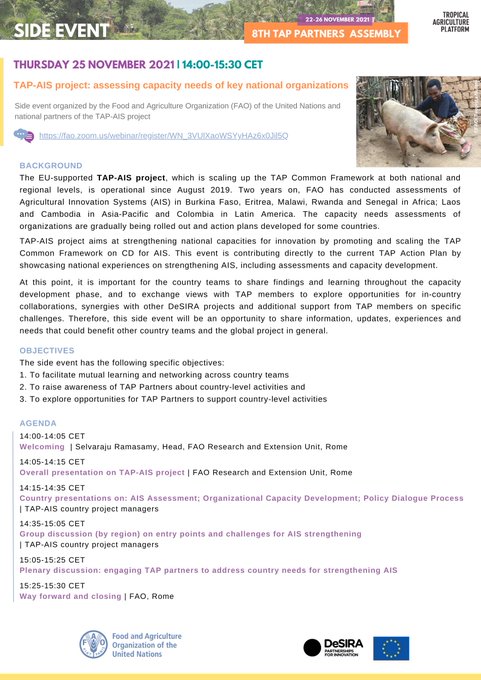
25/11 TAP-AIS project: assessing capacity needs of key national organizations
Two years on, FAO has conducted assessments of Agricultural Innovation Systems (AIS) in Burkina Faso, Eritrea, Malawi, Rwanda, Senegal; Laos, Cambodia and Colombia. The capacity needs assessments of organizations are gradually being rolled out and action plans developed for some countries.
It's important for the country teams to share findings and learning throughout the capacity development phase, and to exchange views with TAP members to explore opportunities for in-country collaborations, synergies with other DeSIRA projects and additional support from TAP members on specific challenges. Therefore, this side event was an opportunity to share information, updates, experiences and needs that could benefit other country teams and the global project in general.
Overall presentation on TAP-AIS project | FAO Research and Extension Unit, Rome
Delgermaa Chuluunbaata, Agricultural extension officer at FAO
Manuela Bucciarelli, Project Management, Monitoring and Evaluation Expert.
Country presentations on: AIS Assessment; Organizational Capacity Development; Policy Dialogue Process
| TAP-AIS country project managers
Moderator Anila Rahim - Pakistan
Aristide Sempore - Burkina Faso
Seyoum Teame - Eritrea
Bun Thol - Cambodia
Vornthalom Chanthavong - Lao DRC
26/11 Ways to Develop Agricultural Innovation Systems (AIS) via Integration of Industry-Education Research (IER)
The AIS is essential for sustainable agriculture development and innovation is one of the main driving forces. Industry, education, and research are basic factors that constitute to the AIS. Industrial demand fuels agricultural innovation and scientific research underpins agricultural development while education cultivates high-quality labor force. A virtuous cycle should be built to bolster the advancement of industry, education and research sectors.
When industry raises a problem, solutions are found via research and cultivate talents to solve the issue, forming a “Three-in-One” mechanism. How to integrate the three factors to drive the agricultural innovation is a question needing further discussion. In order to map out specific ideas and measures for boosting AIS to spur the development of agriculture, Chinese Academy of Tropical Agricultural Sciences (CATAS) and Chinese Academy of Agricultural Sciences (CAAS) organised a webinar on Ways to Develop AIS via Integration of Industry-Education-Research.
Opening remarks |Dr. Selvaraju Ramasamy, Head of FAO-Research and Extension Unit, Rome
Development of AIS through IER Collaboration of CATAS | LIU Kui, CATAS
Practices and Cases on International Cooperation for Agricultural Innovation Capacity of CAAS | HAO Weiping, CAAS
Contributions of CATIE to breeding, agroforestry and education in the coffee sector of the Americas | Rolando Hermes Cerda Bustillos, CATIE
AIS Development through IER Collaboration | John B. William, Alliance of Bioversity International and CIAT
AIS Development through Industry-Education Research (IER) Collaboration of CABI | Claire Curry, CABI
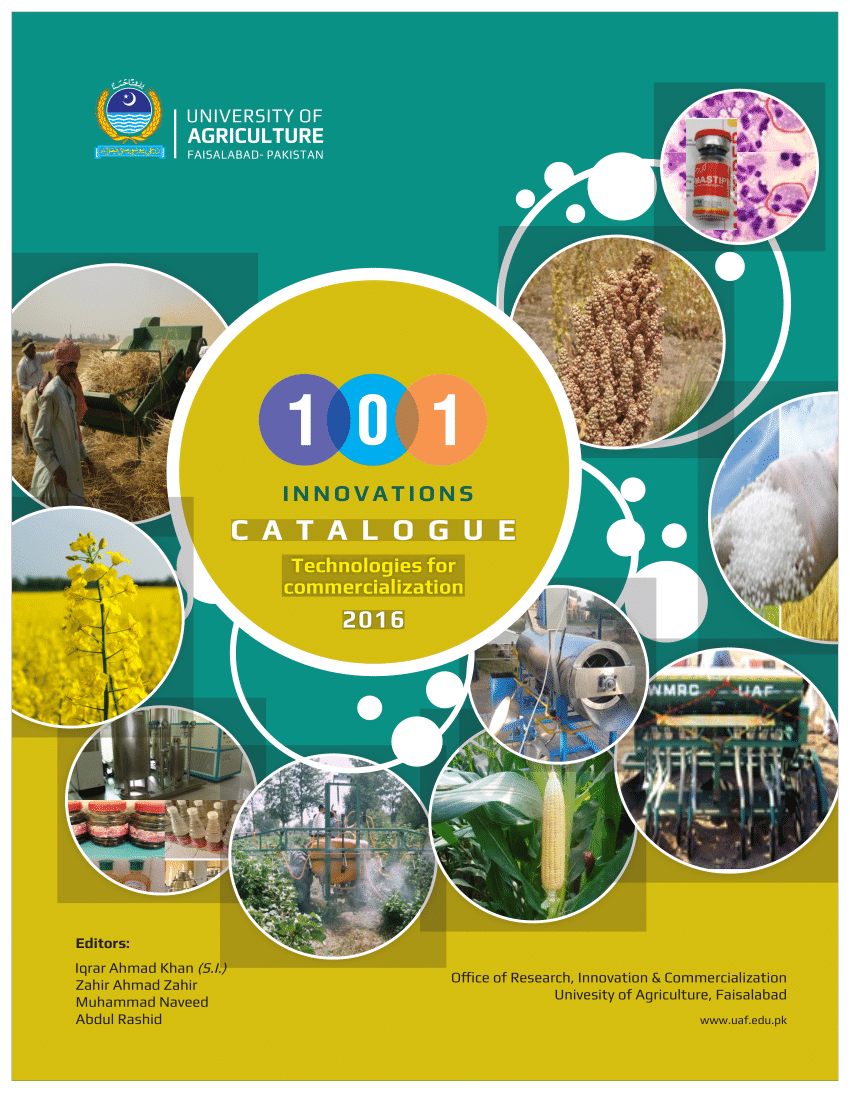
Practice and thought on AIS through Industry-Education Research (IER) Collaboration in Pakistan | Iqrar Ahmad Khan, University of Agriculture, Faisalabad, Pakistan @1:16:46 (video recording)
There are new varieties of cotton and mustard with competitive advantage of determinate growth and
potential for mechanical harvesting.
Three new hybrids of maize with high pro-vitamin A contents are
ready for release in the public domain. Transgenic sugarcane is in the testing process.
Ten new mango
selections are being promoted. Two new breeds of backyard poultry have been developed. A large
number of mechanical and agricultural engineering innovations have been made available for
industrial manufacturing.
There are several soil amendments and databases created to improve soils
and enhance fertilizer use. The plant and animal pests and diseases are being addressed through
environmentally safe interventions. Water and energy solutions have been developed for easy
adoptions with a focus on renewable options.
A special emphasis has been placed on reducing postharvest losses and value addition to capture
markets within- and outside Pakistan. New our blending and fortification technologies are made
available to address the malnutrition in children and women. The value addition also includes value
chain interventions and development of novel products like vaccines, textile stripping technologies,
guar gum control of aflatoxins and silymarin extraction from a weed.
An important limitation to agriculture is delivery of information and services to the farmer. Innovative
applications of ICT have been explored and offered for upscaling by the government and industry.
AIS Development through IER Collaboration of iShamba | Martin Aketch, iShamba, Kenya iShamba Farmer Insights (35 p.)
Mercy Corps’ AgriFin is funded by the Mastercard Foundation and Bill and
Melinda Gates Foundation to help organizations design, test and scale
digitally-enabled services for Africa’s smallholder farmers.
iShamba’s unique services are positively impacting farms and
lives. It can improve farmer satisfaction by addressing their
challenges and incorporating their suggestions for improvement.
Over 90% of farmers reported improvements in their way of farming, farm production
and revenue, and overall quality of life because of iShamba’s agricultural information
service. They spoke about improved knowledge and ability to plan farm activities,
increased yield and volume sold, and having more food for consumption.
Practices and thought on AIS through IER Collaboration of CGCOC Group | WANG Miao, CGCOC Group, China
CGCOC is a mixed-ownership enterprise jointly funded by state-owned enterprises, management teams, local state-owned assets, overseas key employees and external natural persons. CGCOC has formed three regional centers in Africa, namely the eastern Africa, west-central Africa with English speaking regions and French speaking regions, covering 27 countries and accounting for 50% of the whole African countries, among which, CGCOC Nigeria Company has been established for 35 years.
Boost scientific and technological innovation: Construction of Big-data Platform for China Natural Rubber Industry Chain | LI Hantang, CATAS, China
Concluding remarks | LIU Kui, CATAS
26/11 Establishing and Operationalizing a Research, Technology and Innovation Platform for the Date Palm
Integrated Production System in NENA Region
Organized by the Association of Agricultural Research Institutions in the Near East and North Africa (AARINENA)
26/11 How to strenghthen agricultural innovation in Latin America
A session about the challenges and lessons learnt about the adoption of approaches and tools by regional research and extension organizations in Latin America and the Caribbean.
At COP26, the UN Climate Change Conference, WWF championed the role of food systems, calling for them to be placed at the front and centre of climate solutions. We shone a light on some of the overlooked solutions and working with stakeholders from across climate and food systems to build systems-based approaches. In the next 12 months, we hope to see food elevated to the top table and taking its place as one of the most prominent negotiation topics at COP27 in 2022.
WWF is calling on public and private stakeholders to adopt a food systems approach in all climate action. Essential food-based climate commitments that need to be advanced and result in formal commitments at COP27 include:
Include a Food Systems Approach In NDCs
Include a Food Systems Approach in the Koronivia Process
Halt Conversion of Natural Habitats for Food Production
Commit to Turning Food Systems From a Net GHG Emitter to a Net GHG Emissions Sink
Repurposing Food And Agriculture Subsidies to Reward Actions that are Good for Climate, Nature and People
The principles of inclusiveness, respect for human rights, and improvement of the livelihoods of the world’s poorest populations lie at the heart of each commitment and should be used in all decision-making.
The COVID-19 pandemic exposed the vulnerability of agri-food systems to shocks and stresses and led to increased global food insecurity and malnutrition. Action is needed to make agri-food systems more resilient, efficient, sustainable and inclusive.
The State of Food and Agriculture 2021 presents country-level indicators of the resilience of agri-food systems. The indicators measure the robustness of primary production and food availability, as well as physical and economic access to food. They can thus help assess the capacity of national agri-food systems to absorb shocks and stresses, a key aspect of resilience.
The report analyses the vulnerabilities of food supply chains and how rural households cope with risks and shocks. It discusses options to minimize trade-offs that building resilience may have with efficiency and inclusivity. The aim is to offer guidance on policies to enhance food supply chain resilience, support livelihoods in the agri-food system and, in the face of disruption, ensure sustainable access to sufficient, safe and nutritious food to all. CORE MESSAGES
To preserve their functionality and ensure the food security, nutrition and livelihoods of millions of people, agri-food systems must become more resilient to increasing shocks and stresses of diverse origins, both biophysical and socio-economic.
Because agri-food systems are complex – including primary production, food supply chains, domestic transport networks and households – and involve many interlinked actors, a shock in any component can spread rapidly throughout systems.
The fragility of agri-food systems can affect large numbers of people: already 3 billion people cannot afford a healthy diet and an additional 1 billion would join their ranks if a shock reduced their income by one-third. Food costs could increase for up to 845 million people if a disruption to critical transport links were to occur.
Of the five distinct resilience capacities agri-food systems must have – to prevent, anticipate, absorb, adapt and transform – absorptive capacity is critical in confronting unforeseen shocks and is complementary to risk management of shocks that can be anticipated.
Key to building the absorptive capacity of agri-food systems is diversity in food sources (domestic production, imports or existing stocks), diversity of actors in food supply chains, redundant and robust transport networks, and affordability of a healthy diet for all households, particularly the poorest and most vulnerable.
Risk management strategies for shocks such as droughts, floods and pests – including multi-risk assessments, timely forecasts, early warning systems and early action plans – are key to help all agri-food systems’ actors prevent and anticipate major disruptions to systems and avoid human suffering and costly recovery interventions.
Enhancing the resilience of food supply chains requires government support to develop small and medium agri-food enterprises, cooperatives, consortia and clusters, as well as social protection programmes.
Resilience capacities of rural low-income households, in particular small-scale producers whose livelihoods are increasingly vulnerable to climate shocks and depletion of natural resources, can be significantly strengthened through education, non-farm employment and cash transfers.
Ensuring economic access to sufficient food for a healthy diet at all times is a key dimension of agri-food systems’ resilience. Policies and investments that reduce poverty, generate decent employment and expand access to education and basic services, as well as social protection programmes when needed, are essential building blocks of resilience.
Building resilient agri-food systems should be a key policy objective and must ensure that all agri-food systems’ components function well over time. This requires mainstreaming resilience in agri-food policies and greater coordination across all relevant sectors and layers of government institutions to ensure policy coherence.
In the 2021 international agenda on food systems, the Decade of Family Farming 2019-2028 offers the international community an umbrella to achieve positive change with fair transition in food systems.
The UNDFF Global Action Plan-built upon a wide consensus, provides a series of comprehensive actions, from the global, regional to the local levels, to address the challenges and opportunities of family farming.
The Global Conference on Family Farming and Food Systems seeked to scale up the implementation of the UNDFF 2019-2028 towards more sustainable, resilient, inclusive, and viable food systems, contributing directly to the achievement of the SDGs.
More than 300 representatives of governments, family farming organizations, regional platforms, research centers and National Family Farming Committees, international institutions (such as the EU, FAO, IFAD) and development agencies from five continents are invited to participate in the conference.
Mr. Willem Olthof, Deputy Head of Unit for Sustainable Agri-Food Systems and Fisheries, European Commission - DG INTPA
Ms. Isabel Bombal, Director General of Rural Development, Innovation and Agri-Food Training, Ministry of Agriculture, Fisheries and Food of Spain
Mr. Renato Alvarado, Minister of Agriculture and Livestock of the Government of Costa Rica (video)
Mr. Anani Kodjogan Kpadenou, Director of plant sectors in the Ministry of Agriculture, Livestock and Rural Development of Togo
Ms. Esther Penunia, Asian Farmers Association General Secretary
23/11 Rural youth
This session co-organized by IFAD and the WRF provided youth with a space where they can express their proposals in terms of Public Policies and programs that can help them address the challenges that threaten the Family Farming generational renewal. The young farmers might position themselves on how the UNDFF should be exploited to promote more effectively their own policy proposals at the global level and in specific countries in Latin America, Asia and Africa.
Welcome & Introduction
Ms. Sylvie Guillaud, Regional Coordinator for Africa, WRF
Mr. Yoro Thioye, Agricultural Policy Advisor, CNCR, Senegal
Engaging young farmers in policy dialogues UNDFF and its second pillar
Ms. Elizabeth Ssendiwala, Senior Technical Specialist on Rural Institutions for the Asia and the Pacific Region, IFAD
Ms. Anna Korzenszky, Family Farming Consultant, Partnerships and UN Collaboration 3 Division, FAO
Youth Public policies proposals to address their main challenges: the UNDFF as a support for the creation of a right policy environment for the rural youth
Mr. Afantchawo Koudasse, ROPPA, West Africa
Ms. Evaline Aiya, ESAFF, East Africa
Mr. Jumer Marcaida, PAKISAMA-PAMANAKA and AFA, Asia
Ms. Melina Rodríguez, COPROFAM and CNFR, South America
Ms. Sandrine Tsogo, PROPAC, Central Africa
24/11 Strengthening family farming as a pathway to sustainable
food systems transformation
Mr. Dominik Ziller, Vice-President of International Fund for Agricultural Development (IFAD)
Ms. Beth Bechdol, Deputy Director-General Food and Agriculture Organization (FAO)
Mr. Zainal Arifin Fuad, International Coordination Committee member of LVC
Mr. Sok Sotha, Miembro de la Junta Directiva de la Organización Mundial de los Agricultores (WFO-OMA)
24/11 Promoting inclusive value chains and market access for
family farmers
This panel discussed proposals for market access and the creation and distribution of greater value for family farming production, ensuring family farming’s leadership in the shift towards more sustainable, resilient, inclusive and viable food systems Panel 2: Promoting inclusive value chains and market access for family farmers
3 successful experiences on access to inclusive markets and value chains:
Experience about partnership between farmers and private sector in Senegal. Presented by Mr. Pierre Ndiaye, CEO of the Senegalese SME Mamelles Jaboot.
Experience from Bolivia about mobile markets during pandemic period and beyond
Mr. Rene Genaro Rojas Velasco, President of CIOEC Bolivia
Experience about generation of added value in the cacao production from Indonesian farmers. Presented by Ms. Dyah Aryani, Ngudi Mulyo Farmers Union.
Comments & Conclusions
Mr. Regis Méritan, Head of Agriculture Growth Sector at Sustainable Agri-Food systems and Fisheries Unit, European Commission – DG INTPA
Mr. Hakim Balinaire, President of ESAF
25/11 Public policies to increase the participation of family farming in the food systems
This panel discussed the generation of enabling policy environments (legal and institutional frameworks, political commitments, etc.), which ensure family farming leadership in the shift towards sustainable, resilient, inclusive and viable food systems. A key element to ensure that challenges and opportunities are well identified is to increase the participation of family farmers in decision-making processes. National Action Plans for the Decade and family farming laws and regulations will be outlined.
This session, co-organised by the ILC and the WRF, will provide a space to understand the inequalities around the access to land and the impact it has on family farming; and to show the potential of National Plans to address land inequality in favour of family farming. Special session on land tenure rights
State of Play: Land Inequality report - Mr. Ward Anseeuw, Senior Technical Specialist Knowledge, Learning and Innovation, International Land Coalition
Mr. Aleksandr Temirbekov, NUWUA – National Civil Society Committee on Family Farming of Kyrgyzstan
Mr. Esteban Daza, IEE – National Committee for Peasant Family Farming
Mr. Adriano Campolina, Representative FAOFR
26/11 HIGH LEVEL PANEL: SCALING UP THE UN DECADE OF FAMILY FARMING
Emerging opportunities for the success of the Decade of Family Farming. Introduction to the Family Farming Coalition
Ms. Pilar Cancela Rodríguez, Secretary of State for International Cooperation of the Government of Spain
Mr. Mario Arvelo, Ambassador of the Dominican Republic to the Rome-based UN Agencies
Ms. Josyline C. Javelosa, Ph.D., Agriculture Attaché and Deputy Permanent Representative of the Philippines to the Rome-based International Organisations
Ms. Esther Penunia, Secretary General of AFA
M. Nathanael Buka Mupungu, President of PAFO (Organisation Panafricaine des Producteurs Agricoles) and PROPAC (Plateforme Régionale des Organisations Paysannes d’Afrique Centrale)
Ms. Laura Pacheco Ovares, Vice-Minister of Agriculture and Food of Costa Rica
Conclusions and closing
Mr. Gabriel Ferrero, Ambassador-at-Large for Global Food Security at Ministry of Foreign Affairs, European Union and Cooperation, Spain, and Chairman of the Committee on World Food Security (CFS)
26/11 Communication activities
Mario Acunzo, FAO – Regional Initiatives & UNDFF Participatory Communication Plans
Phouttasinh Phimmachanch, AFA – ComDev Asia: Enhancing communication capacities of family farmers
Mateus Costa Santos, LVC – Yenkasa Africa: Giving voice to African farmers.
Laura Ramirez, READCAF Costa Rica – Onda Rural: Estrategia CpD para el PNAF
Namita Sing, Digital Green – Promoting Rural Communication Services for Family Farming
In the context of this institutional process of change, One CGIAR will work with partners not only on research but also on integrated technological and institutional innovations, capacity development and policy engagement, to address the food, land and water systems challenges in a climate crisis, in six regions of the world: (i) Latin America and the Caribbean (LAC); (ii) Central and West Asia and North Africa (CWANA); (iii) West and Central Africa (WCA); (iv) East and Southern Africa (ESA); (v) South Asia (SA); and (vi) South East Asia and the Pacific (SEA).
EU Platforms
Various programmes of the European Union with Africa aim to support agriculture, food and bio-economy chains in the continent.
Food and nutrition security and sustainable agriculture was the first common priority research and innovation area, as part of the AU-EU High-Level Policy Dialogue (HLPD) on Science, Technology and Innovation, embedded in the Joint Africa-EU Strategy (JAES). Topics are discussed and implemented through the WG on Food Nutrition Security and Sustainable Agriculture (FNSSA). Furthermore, with the launch of the EU’s R&I programme - Horizon Europe (HE) – several calls of the Africa Initiative target actions towards these crucial issues.
Then, the European Innovation Partnership for Agricultural Productivity and Sustainability (EIP-AGRI) targets to stimulate innovation and seeks practical solutions to on-farm problems by bridging the gap between practice and science.
The DeSIRA initiative aims to contribute to climate-relevant, productive and sustainable transformation of agriculture and food systems in low and middle-income countries.
Afterwards, African Union Research Grants (AURG) programme provides funding to the African Union Commission to organize calls for proposals for collaborative research projects - the first call related to 'sustainable intensification' in agriculture, in line with the priorities of the Africa-EU High-Level Dialogue on Research and Innovation.
Finally, the Pan African Network on economic Analysis of Policies (PANAP) provides dedicated support in the framework of the AU-EU partnership on Agriculture; it is among the first EU plans supporting African policymakers with dedicated analyses of policy impact with focus on the ag-food sector and rural areas. The cooperation covers selected African countries and regions. It supports projects with local, country level, trans-regional, continental and global added-value in areas of shared interest, and offers new possibilities for the EU and Africa to work together.
Objectives of the seminar
To share with research partners across Africa the EU Science and Innovation Division Programs
To share on the one CGIAR reform processes and some priorities for the ESA and WCA regions.
Opening
Welcome and introduction including the objectives of the seminar
Dr. Siboniso Moyo
Deputy Director-General, Research and Development – Biosciences Livestock Genetics, Feeds and Forages International Livestock Research Institute
Dr. Piero Venturi
European Union Science Counsellor to the African Union, European Commission
Opening Remarks
Forum for Agricultural Research in Africa (FARA)
Dr. Yemi Akinbamijo
Executive Director, Forum for Agricultural Research in Africa (FARA)
CGIAR System Organization
Dr. Kundhavi Kadiresan
Managing Director, Global Engagement and Innovation, CGIAR System Organization
Introduction to the One CGIAR Research and Innovation Strategy
Dr. Harold Roy-Macauley
Regional Director, East, and Southern Africa, One CGIAR, and Director General of the Africa Rice Center
Presentation and discussion on EU Platforms in Agriculture, food and bioeconomy
Presentations from the European Commission DG RTD and AGRI on HLPD, HE, Africa Initiative, EIP-AGRI
Dr. Hans-Joerg Lutzeyer
Senior Research Policy Officer, SCAR Secretariat, EU-African Union Food Systems R&I, Horizon Europe Food Systems Partnership
The discussion revolved around how MSPs could enhance the sense of ownership, support developing knowledge, create linkages between different governance levels and a wide variety of actors, and, most significantly, improve policy making.
Philippe Petithuguenin - Deputy Director General in charge of Research and Strategy- CIRAD (The French Agricultural Research Centre for International Development)
Simon Winter - Chair of the Steering Committee of the Farm to Market Alliance and Chair of the Board of ACRE Africa
The past decade has seen renewed, and more concerted and comprehensive interest in gender equality and women’s empowerment in the agricultural development sector. This momentum has created a unique opportunity to advance gender equality, and to institutionalize gender research within agricultural research for development (AR4D) organizations. A new book “Advancing Gender Equality through Agricultural and Environmental Research: Past, Present, and Future” is a part of this overall momentum and the growing body of evidence and ideas it is generating.
The book marks a shift away from a typical, instrumentalist outlook focused on how gender analysis can contribute to research objectives, such as improved productivity. Over 55 gender researchers who contributed to this book intentionally flip the question to ask: How does agricultural and environmental research and development contribute to gender equality and women’s empowerment?
The book highlights the history and wealth of gender knowledge that has been generated to date by researchers from CGIAR — an international partnership of agricultural and environmental research institutes — and beyond. For CGIAR, this is an opportune moment to take stock of progress and articulate a forward-looking agenda for future gender research with gender equality and women’s empowerment at the center.
Rhiannon Pyburn, NL-CGIAR senior expert and senior advisor, KIT Royal Tropical Institute; leader of Collaborative Gender Research cluster in the CGIAR Research Program on Policies, Institutions, and Markets (PIM) (Presentation)
Vivian Polar, Gender, Monitoring and Evaluation Specialist; Gender research coordinator, CGIAR Research Program on Roots, Tubers and Bananas (RTB), International Potato Center (CIP) (Presentation)
Iliana Monterroso Ibarra, Scientist, Co-Coordinator of Gender and Social Inclusion Research, Center for International Forestry Research (CIFOR) (Presentation)
Cynthia McDougall, Senior Research Fellow - Gender, Environment and Development, Stockholm Environment Institute (SEI) (Presentation)
Discussants
Susan Kaaria, Senior Gender Officer, Inclusive Rural Transformation and Gender Equality Division, Food and Agriculture Organization (FAO)









 Panel 2: Promoting inclusive value chains and market access for family farmers
 Ep. 2: Public policies to increase the participation of Family Farming in the Food systems