Platform for African – European Partnership in Agricultural Research for Development

Wednesday, May 3, 2023

AR4D Funding Opportunities for Africa – May 2023

Agriculture Fisheries Forestry


World Academy of Sciences

Prize in Agricultural Sciences or Biology

2023-05-15

The World Academy of Sciences (TWAS) invites nominations for the Fayzah M. Al-Kharafi Award in Agricultural Sciences or Biology. The prize aims to recognize scientists for their achievements in Agricultural Sciences or Biology. Eligible nominees are female scientists from scientifically and technologically lagging countries. The prize is a US$4 thousand cash award. Nominations should be submitted electronically before 15 May 2023.

Japan International Research Center for Agricultural Sciences

International Awards for Young Agricultural Researchers 2023

2023-05-19

The Japan International Research Center for Agricultural Sciences (JIRCAS) and the Ministry of Agriculture, Forestry and Fisheries (MAFF) of Japan make research awards in agriculture. Up to three young agricultural researchers with outstanding research proposals in agriculture, forestry, fisheries and related themes will receive US$5 thousand each to further their research. Applicants must be nationals of a developing country, and belong to a non-Japanese research institute or a non-Japanese university. Candidates need to be younger than age 40 to be eligible. The deadline for applications is 19 May 2023.

Ekhaga Foundation

Ecological Agriculture and Biological Medicine

2023-05-20

The Ekhaga Foundation makes research grants in ecological agriculture and biological medicine. The main focus should be on scientific research and primarily applied research. Ekhagastiftelsen wishes primarily to support strategic and innovative projects of a pilot nature, as well as research that is highly newsworthy and that not just confirms previous findings. It is possible to apply for scholarships, but this is usually only granted for research-related projects. There is no maximum amount. Please note that the total amount awarded is usually in the range SEK 10-15 million. Universities, research institutes, etc., from all over the world are invited to apply. Cooperation with a Swedish institution is an advantage but not a requirement. The deadline for applications is 20 May 2023.

U. S. Department of Agriculture

Food for Progress Program

2023-05-24

The Food for Progress Program provides for the donation of U.S. agricultural commodities to developing countries committed to expanding free enterprise in the agricultural sector. The objective is to improve agricultural productivity and to expand trade of agricultural products. The Program has prioritized the following areas: the Cacao sector, the Coffee sector, the Spices sector, Sanitary and Phytosanitary Standards, the Trade Facilitation Agreement, and Climate Smart Agriculture. The estimated funding per award is US$20-US$39 million. The following entities are eligible to apply: governments of emerging agricultural countries, nonprofit organizations, universities, and any other private entity. The closing date for applications is 24 May 2024.


Biodiversity Conservation Wildlife

AFR100 Initiative

Restoring African Landscapes

2023-05-05

The AFR100 Initiative seeks to show that restoration can create a prosperous, net-zero-emissions future for Africa. Therefore, the initiative will finance 100 non-profit community organizations and for-profit businesses that are restoring land by planting and growing trees in rural and urban landscapes. Early-stage for-profit businesses or non-profit organizations can apply for US$50 thousand to US$150 thousand. Growth stage organizations can apply for US$250 thousand to US$500 thousand. Deadline to submit Expressions of Interest is 05 May 2023.

Zoological Society of London

Protected and Conserved Area Fund

2023-05-08

The EDGE Protected and Conserved Area Fund supports projects with a clear focus on creating new protected or conserved areas or the expansion of existing protected or conserved areas. Projects should focus on creating a new protected area or the expansion of existing protected areas. Projects should have endorsement from local communities. Applications are due by 08 May 2023.

Wildlife Acoustics

Bio-Acoustics Product Grants

2023-05-15

Wildlife Acoustics aims to advance animal biology research, habitat monitoring and environmental conservation through bio-acoustics recording technology. The Wildlife Acoustics Scientific Product Grant Program offers US$4 thousand of product-in-kind grants to biologists, researchers, conservationists, and students who work for charitable, educational, and other tax-exempt organizations. There are no geographical limitations. Applications are evaluated quarterly with deadlines on 15 February, 15 May, 15 August, and 15 November.

Ekhaga Foundation

Ecological Agriculture and Biological Medicine

2023-05-20

The Ekhaga Foundation makes research grants in ecological agriculture and biological medicine. The main focus should be on scientific research and primarily applied research. Ekhagastiftelsen wishes primarily to support strategic and innovative projects of a pilot nature, as well as research that is highly newsworthy and that not just confirms previous findings. It is possible to apply for scholarships, but this is usually only granted for research-related projects. There is no maximum amount. Please note that the total amount awarded is usually in the range SEK 10-15 million. Universities, research institutes, etc., from all over the world are invited to apply. Cooperation with a Swedish institution is an advantage but not a requirement. The deadline for applications is 20 May 2023.

U.S. Department of State

Congo Basin Conclave

2023-05-22

The U.S. Embassy in Kinshasa announces an open competition for organizations to submit applications to organize a regional conclave bringing together stakeholders working to preserve the Congo Basin. Phase one of the project will start with country-specific sessions for U.S. government selected participants. During phase two of the project, a maximum of 50 participants from the five country specific sessions will gather in Kinshasa for a 1-2 day Congo Basin Conclave. The Conclave will provide a forum that enables experts to network across borders. Finally, participants will conceive and propose projects for U.S. government funding that invest in the people of the Congo Basin. Awards to organize the conclave may range from US$200 thousand to US$250 thousand. Eligibility to apply extends to non-profit organizations, individuals, non-profit educational institutions and governmental institutions from the U.S. and the Democratic Republic of the Congo. The application deadline is 22 May 2023.

U.S. Department of State

Countering Wildlife Trafficking in Sub-Saharan Africa

2023-05-29

The U.S. Department of State seeks to strengthen the capacity of wildlife and timber-related institutions and actors in Sub-Saharan Africa. The call seeks to enhance law enforcement and justice sector efforts to counter wildlife trafficking, ultimately helping to disrupt wildlife trafficking operations, and removing opportunities for criminal organizations to profit from illicit proceeds derived from the wildlife trade. Funding ranges from US$500 thousand to US$2 million. Eligibility for this award is restricted to US-based and foreign non-profit organizations and educational institutions. Applications have to be received by 29 May 2023.

Oak Spring Garden Foundation

Plant Conservation Biology Fellowship

2023-05-31

The Oak Spring Garden Foundation awards Fellowships in Plant Conservation Biology to one early-career practitioner working on issues related to plant and landscape conservation. The award includes a US$10 thousand individual grant and requires a 2 to 8 week stay at Oak Spring (USA). Applicants must be early-career practitioners, scholars or scientists, not enrolled in an undergraduate degree program in 2024. The deadline for applications is 31 May 2023.

Oak Spring Garden Foundation

Plant Science Research Fellowship

2023-05-31

The Oak Spring Garden Foundation awards Fellowships in Spring Fellowship in Plant Science Research to one early-career plant scientist, with preference given to scientists working in organismal plant biology. The award includes a US$10 thousand individual grant and requires a 2 to 8 week stay at Oak Spring (USA). Applicants must be early-career scientists who have completed their undergraduate degree within the past ten years. The deadline for applications is 31 May 2023.


Crosscutting


University of Bonn

SDG Fellowships

2023-05-03

The University of Bonn invites international postdoctoral fellows for a joint research project on the Sustainable Development Goals (SDGs). The scientists will research and teach together with a professor from the University of Bonn for one or two semesters. The university seeks collaborations with universities and research institutes in Africa, Asia and Latin America. Post-doctoral researchers invited by a professor of the University of Bonn for a joint research project are eligible. The funding can cover a travel allowance, a scholarship of €3 thousand per month and a research expense allowance of up to €500 per month. The application must be submitted by a full-time professor at the University of Bonn together with the fellow. The submission deadline is 03 May 2023.

United Nations Development Programme

Young Leaders Development Program

2023-05-07

The United Nations Development Programme (UNDP) and Samsung Mobile announce Generation17 – a joint initiative aimed at empowering young changemakers to achieve Sustainable Development Goals. Samsung and UNDP provide mentorship, technology, and networking opportunities to 14 young leaders across six world regions. Applicants need to be between 18-30 years at the time of application. Applications have to be submitted by 07 May 2023.

Nature Research

Awards for Inspiring Science and Innovating Science

2023-05-08

Nature Research seeks applications for the Nature Research Award. The Scientific Achievement Category celebrates an outstanding female early-career researcher, the Science Outreach Category will honor an individual or organization who has driven initiatives to encourage girls or young women to engage with STEM subjects around the world. The call closes on 08 May 2023.

Massachusetts Institute of Technology

Solve Global Challenges

2023-05-09

The “Solve” program at MIT announces five global challenges in 2023, inviting anyone in the world to propose solutions to them. The 2023 challenges include one on climate ecosystems and low-carbon housing. MIT Resilient Ecosystems Challenge seeks technology-based solutions that help communities restore, sustain, and benefit from resilient ecosystems. The winner receives a US$10 thousand grant. Additional prizes (from US$75 thousand to US$150 thousand) for solutions addressing specific challenges are available. The deadline for project draft submission is 09 May 2023.

iF International Forum Design GmbH

Social Impact Prize

2023-05-09

The iF Social Impact Prize aims to publish and support design projects that contribute to solving urgent challenges and help to improve living conditions in the developing world. Solutions should already be established and help to solve well known issues in any category of the UN Sustainable Development Goals. The best projects will share a cash prize of €100 thousand in total. Eligibility extends to non-profit organizations, companies and foundations (student concepts will not be accepted). Social projects can be submitted until 09 May 2023.

Regional Studies Association

Research Grants

2023-05-10

The Regional Studies Association (RSA) supports outstanding individual researchers on topics related to regional studies and regional science. Individuals can apply for up to £5 thousand for projects of up to 18 months in duration. Please note that applicants have to be RSA members (non-members may apply and join RSA at the same time). Grants have no geographical limitation, past grant holders come from Egypt, Argentina, China, etc. Expressions of Interest have to be submitted by 10 May 2023.

Regional Studies Association

Early-Career Grant

2023-05-10

The Regional Studies Association (RSA) covers issues in the fields of climate change, energy, migration, and economic development. RSA makes grants to early-career researchers in support of their regional studies and/or regional science research. Individuals can apply for up to £10 thousand for projects of up to 18 months in duration. Please note that applicants have to be RSA members (non-members may apply and join RSA at the same time). Grants have no geographical limitation, past grant holders come from Egypt, Argentina, China, etc. Expressions of Interest have to be submitted by 10 May 2023.

Earth Journalism Network

Media Workshop on Covering Marine Pollution

2023-05-10

The Earth Journalism Network (EJN) hosts a virtual media workshop (June 2023) for journalists interested in reporting on marine pollution. Journalists will have the opportunity to workshop their story ideas, network with peers and editors, and connect with thematic experts and sources for their reporting. Applicants can be from any country in the world. Applicants from coastal countries are preferred. Selected participants will be eligible to apply for a story grant. The application deadline is 10 May 2023.

African Business Heroes

ABH Prize Competition 2023

2023-05-12

African Business Heroes aims to support the next generation of African entrepreneurs who are making a difference in their local communities by working to solve the most pressing problems. Applications are open in English and French to entrepreneurs from all African countries, all sectors, and all ages. Ten finalists will compete for a share of US$1.5 million in grant money. All Finalists win grant funds from US$100-300 thousand. The applicant must be the Founder or a Co-Founder of the company. Applications close on 12 May 2023.

D-Prize

Funding Entrepreneurs to Alleviate Poverty

2023-05-14

The D-Prize funds pilot projects that more widely distribute relatively low-cost products and services in the fight against poverty. The current challenges include social enterprises for innovations in specified themes of agriculture; energy; WASH; and several other categories. The D-Prize will award 30 teams with up to US$20 thousand each to launch nonprofits or social ventures that can distribute proven poverty interventions to people in need. Eligibility to compete extends to entrepreneurs anywhere in the world, and of any age or background. The D-Prize invites concept notes before 14 May 2023 (early deadline); 04 June 2023 (regular deadline); or 25 June 2023 (limited extension).

Village Capital

Ecosystem Restoration

2023-05-14

Village Capital supports 10-12 impact-driven startups building locally viable ecosystem restoration solutions in Africa. The program addresses entrepreneurs championing forest restoration, biodiversity conservation, wetland restoration and water conservation, sustainable agriculture and climate tech solutions. Participants will receive mentorship and access to an investment analyst. Eligibility extends to (for-profit) startups building locally viable ecosystem restoration solutions. The startup has to have legal incorporation and operations in at least one Sub-Saharan African country. Applications close 14 May 2023.

OceanHub Africa

Acceleration Program

2023-05-14

OceanHub Africa supports African for-profit startups focused on preserving and restoring the health of the ocean. The 6-month acceleration program provides mentorship, services, software, fundraising support and a network of leading ocean experts, mentors (entrepreneurs, investors, innovation experts, impact experts, scientists, lawyers, etc.), impact investors and potential clients. Eligibility extends to for-profit start-ups operating in Africa and with clear focus on ocean issues (e.g., climate change, pollution or overexploitation). The application deadline is 14 May 2023.

Partnership for Observation of the Global Oceans

Fellowships 2023

2023-05-15

The Partnership for Observation of the Global Oceans (POGO) supports capacity building in oceanography for individuals and institutions in developing countries. POGO's Visiting Fellowships Program is open to scientists, technicians, graduate students (PhD), and post-doctoral fellows involved in oceanographic work. Priority is given to applicants in their early stages of career development. The fellowship offers the opportunity to visit other oceanographic centers for a short period of training on any aspect of oceanographic observations, analyses, and interpretation. The application deadline is 15 May 2023.

Einstein Forum

Einstein Fellowship 2024

2023-05-15

The Einstein Forum and the Daimler and the Wittenstein Foundation offer a fellowship for early-career researchers who wish to pursue a project in a different field from that of their previous research. Please note that the proposed project must be significantly different in content, field and form, from the applicant’s previous work. The fellowship includes living accommodations for up to 6 months in Caputh (Germany). The fellow will receive a stipend of €10 thousand and reimbursement of travel expenses. Candidates must be under 35 and hold a university degree in the humanities, in the social sciences, or in the natural sciences. Applicants have to submit their application by 15 May 2023.

U.S. Department of State

Community Solutions Program

2023-05-15

The Community Solutions Program (CSP) a global initiative that supports community leaders (ages 26-39) working to address economic, environmental, political, and social challenges confronting their local communities. CSP invites proposals from public and private non-profit organizations worldwide to conduct this international leadership program. The total award made available under this program is US$2.5 million. The closing date for applications is 15 May 2023.

Canada Fund for Local Initiatives

Community Projects in Burkina Faso

2023-05-15

The Canada Fund for Local Initiatives (CFLI) invites proposals that meet the needs of local communities in Burkina Faso. The priorities under this call include women’s economic rights, decent jobs and entrepreneurship, investing in the poorest and most vulnerable. The average contribution is C$25 thousand to C$50 thousand per project. Eligibility extends to not-for-profit local, national or community-based organizations. The deadline for submission is 15 May 2023.

World Academy of Sciences

Young Scientists Award for Frontier Science

2023-05-15

The World Academy of Sciences (TWAS) recognizes scientific achievements by young scientists living and working in a developing country. The third edition of the TWAS-CAS award will recognize achievements in Earth Sciences. The award is worth US$10 thousand. TWAS invites nominations from science academies, national research councils, universities and scientific institutions. Self nominations will not be considered. Eligible candidates are young scientists (not older than 45 years of age). The deadline for receiving nominations is 15 May 2023.

Fondation Yves Rocher

Photography Award, Environment and the Planet 2023

2023-05-18

The Yves Rocher Foundation's Photography Award is awarded to a professional photographer who wishes to make a journalistic study of issues relating to the environment, humanity's relationship with the planet, or the core challenges to sustainability. Eligibility extends to professional photojournalists who are able to write and speak in French or English. The winner will receive an award of €8 thousand. The closing date for applications is 18 May 2023.

Gerson Lehrman Group

Social Impact Fellowship

2023-05-19

The GLG Social Impact Fellowship provides nonprofits and social enterprises with a two-year pro bono partnership with GLG. The Gerson Lehrman Group welcomes applications from organizations working across all issue areas, including but not limited to education, environment, global health, and social justice. Fellows can work anywhere in the world. Applications close on 19 May 2023.

ClimateScience

Olympiad 2023

2023-05-20

ClimateScience is a global charity creating and providing educational resources on solutions to climate change to people worldwide. ClimateScience invites youth from 14-17 years and 18-25 years to participate in the Climate Science Olympiad 2023. Participants can compete in teams of two or on their own. Individual applicants can be matched up with a teammate. Each team (or individual) chooses one of three problem statements (topics: biodiversity, clean energy, and sustainable agriculture) to respond to. The top 3 teams win US$5 thousand, US$3 thousand and US$2 thousand, respectively. Registration ends on 20 May 2023.

Orange Telecom

Orange Social Venture Prize 2023

2023-05-21

The Orange Social Venture Prize recognizes entrepreneurs and start-up organizations that make innovative use of technology in agriculture, energy, and other fields of development. The geographical focus is Africa and the Middle East. Prizes range from €10 thousand to €25 thousand, plus professional support for a period of six months. In addition, Orange will reward more start-ups with the International Women’s Prize worth €20 thousand. The registration deadline is 21 May 2023.

U.S. Embassy in Cameroon

Fulbright Visiting Scholar Program

2023-05-22

The U.S. Embassy in Cameroon seeks qualified candidates for the 2024-2025 Fulbright African Research Scholar Program. Awards of 3 to 9 months are offered for African university faculty or research institute professionals to conduct research in any academic discipline at a U.S. academic or research institution. The deadline for applications is 22 May 2023.

Teach A Man To Fish

School Enterprise Challenge 2023

2023-05-23

The School Enterprise Challenge is an international business program for schools run by the educational charity Teach A Man To Fish. It guides and supports teachers and students to plan and set up real, sustainable school businesses and generate real profits to help support their school or a social cause of their choice. Thematic areas include agriculture, drinking water and sanitation, and the environment, among others. Prizes are between US$250 and US$5 thousand, including in-kind donations like laptops and cameras. Please note that only pre-primary schools, primary schools, secondary schools and technical/vocational colleges are eligible (universities are not eligible to apply). The deadlines for project submission are 23 May, 23 August, and 23 November 2023.

The Association of Commonwealth Universities

Queen Elizabeth Commonwealth Scholarships 2023/2024

2023-05-24

The Association of Commonwealth Universities (ACU) supports the Queen Elizabeth Commonwealth Scholarships for citizens of developing Commonwealth countries. The scholarships fund cultural and academic exchanges and are awarded across many subjects, including climate resilience and life sciences. Eligibility extends to citizens of (or with refugee status in) a Commonwealth country other than the country hosting the award. Scholarships cover tuition fees, living expenses (stipend) for duration of award, return economy flight, one-off arrival allowance and research support grant (on request). The application deadline is 24 May 2023.

World Bank

Joint Japan/World Bank Graduate Scholarship Program

2023-05-26

The JJ/WBGSP Scholarship Program provides scholarships to professionals from developing countries who are applying to a master degree program in a development-related topic. Applicants must first apply for admission to one or more of the Partner Master’s Degree Programs to be eligible for a scholarship. Scholarship recipients receive travel allowance; tuition for the graduate program; basic medical insurance; and a monthly subsistence allowance to cover all living expenses (accommodations, food, etc., including books). The call has to applications windows, with deadlines on 28 February 2023 (Window #1) and 26 May 2023 (Window #2).

Slovak Republic

Slovak Government Scholarships 2023-2024

2023-05-30

As part of its program of official development assistance, the Slovak Republic annually awards scholarships to support qualified international students for studies at Slovak universities. The fields of study include ecological and environmental sciences; agriculture, forestry, and veterinary medicine; water resources management; and several others. Eligible countries for scholarships are Afghanistan, Albania, Armenia, Azerbaijan, Belarus, Bosnia and Herzegovina, Georgia, Kenya, Kosovo, Moldova, Mongolia, Palestinian Territories, Ukraine, and Vietnam. The application deadline is 30 May 2023.

Institute of Current World Affairs

Fellowship Program 2023

2023-05-31

The Institute of Current World Affairs (ICWA) makes grants to support fellows who carry out self-designed independent studies for a minimum of two years in the developing world. Fellows must hold the promise of enriching public life in the United States by enhancing the understanding of foreign countries, cultures and trends, therefore candidates must show strong and credible ties to U.S. society. Proposals in the fields of environment, climate change, sustainability and conservation are welcome. Candidates who seek fellowships may reside in any developing country. Letters of interest must be submitted by 31 May 2023.

Right Sharing of World Resources

Seed Grants for Women's Micro-Credit Projects

2023-05-31

Right Sharing of World Resources (RSWR) makes seed grants to support income-generating projects led by women. RSWR's current priorities are grassroots organizations selected states and districts of India; Quaker groups in Kenya and Sierra Leone. Projects include many in the production and sale of fruits and vegetables; meat and milk; grain crops; fish; fuelwood; and other enterprises associated with small-scale agriculture and rural livelihoods. Grants are usually US$5,500 (but many are considerably smaller) for a one year project. RSWR has two funding cycles with deadlines on May 31 and November 30 each year. (However, RSWR recommends earlier submissions of at least a month prior to the deadline to allow time for revisions.)

Mastercard Foundation

Scholars Program at KNUST

2023-05-31

The Mastercard Foundation provides economically disadvantaged young people in Ghana and Africa with access to university education. The Scholars Program at the Kwame Nkrumah University of Science & Technology (Ghana) provides financial support (tuition, accommodation, learning materials, transportation and monthly stipend) for studies in all subject areas; however, there is preference for science students (including agriculture and natural resources). Applicants must prove critical economic needs to be eligible. Applications close on 31 May 2023.

Beit Trust

Support for Community and Conservation Projects

2023-05-31

The Beit Trust supports projects for health, education, welfare, and environment in Zambia, Zimbabwe and Malawi. Themes include wildlife conservation. Additionally, the Trust’s interests in community welfare include drinking water and irrigation water. Grants do not normally exceed £50 thousand. Applications should be submitted by the end of May and November each year.

Oak Spring Garden Foundation

Botanical Artist Residency Program

2023-05-31

The Oak Spring Garden Foundation supports botanical artists working nationally and internationally who can create beautiful and scientifically accurate depictions of plant species. This award includes a US$1 thousand individual grant and a one to four week residence at Oak Springs (USA) when spring is underway and the gardens and landscape are in bloom. Applicants must be early-career artists not enrolled in an undergraduate degree program in 2024. The deadline for applications is 31 May 2023.

Oak Spring Garden Foundation

Interdisciplinary Residency Program

2023-05-31

The Oak Spring Garden Foundation hosts five separate five-week interdisciplinary residencies. Each session is designed to support eight artists, conservation practitioners, researchers, scholars, scientists or writers who are pursuing work inspired by plants, gardens and landscapes. Participants will receive a US$2 thousand individual grant and a five week residence at Oak Springs (USA). Awardees cannot be currently enrolled in an undergraduate degree program. The deadline for applications is 31 May 2023.

Oak Spring Garden Foundation

Fellowship for Artistic Excellence

2023-05-31

The Oak Spring Garden Foundation awards the annual Eliza Moore Fellowship for Artistic Excellence to one early-career artist who is developing new works that address plants, gardens, or landscapes in the broad sense. The award includes a US$10 thousand individual grant and requires a 2 to 8 week stay at Oak Spring (USA). Applicants must be early-career artists not enrolled in an undergraduate degree program in 2024. The deadline for applications is 31 May 2023.

United Nations Educational, Scientific, and Cultural Organization

Silk Roads Youth Research Grant

2023-05-31

UNESCO launches the ‘Silk Roads Youth Research Grant’. The program aims to mobilize young researchers for further study of the Silk Roads shared heritage, and will award 12 research grants to young researchers under 35 years of age. Grant applicants are invited to address areas of academic study which relate to the shared heritage and plural identities of the Silk Roads, including, but not limited to Science and Technology (however, proposed projects must focus on the results of cultural interactions and exchanges). The proposed research may be carried out by an individual researcher or may be part of a group or collaborative project. UNESCO will award 12 grants of US$10 thousand. The deadline for proposals is 31 May 2023.

Alliance for a Green Revolution in Africa

Women Agripreneur Awards

2023-05-31

Applications are open for the VALUE4HER Women Agripreneur of the Year Awards (WAYA). The award recognizes African women agripreneurs who have demonstrated remarkable innovation in their business by having an impact in food security, climate resilience, women and youth employment. WAYA recognizes women in three distinct categories, with each receiving a US$20 thousand cash prize. Applicants must be operating in agriculture/agribusiness value chains in one of 54 African countries. The deadline for applications is 31 May 2023.

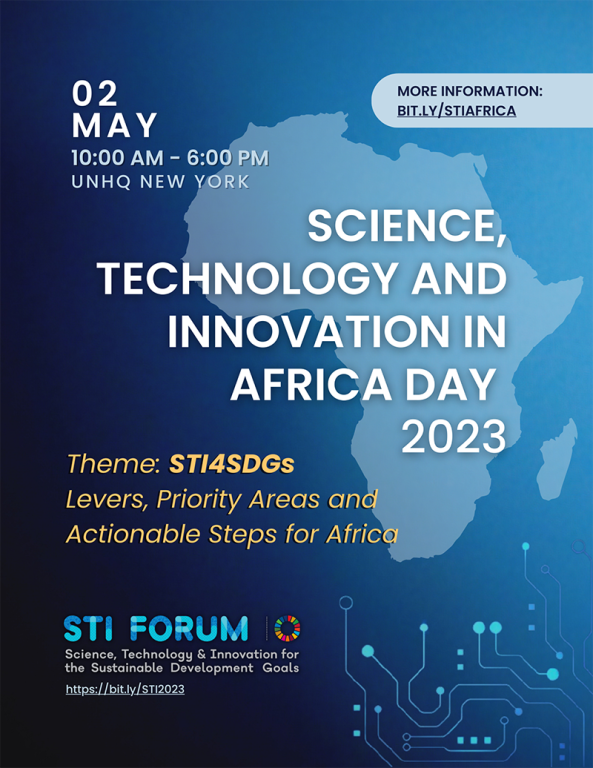
Science, Technology and Innovation in Africa Day 2023

2 May 2023. Science, Technology and Innovation in Africa Day 2023  

The first STI in Africa Day was held at the margins of the STI Forum in New York, with a focus on STI4SDGs: Priority Areas, Levers and Actionable Steps for Africa, as a side event to the  8th Multi-stakeholder Forum on Science, Technology and Innovation for the Sustainable Development Goals 2-5 May 2023.

The STI in Africa Day had two main purposes
  1. To serve as a vehicle for connecting the global community to cooperate, network, showcase, share experiences, build strategic alliances, and, wherever possible, set in motion concrete actions that advance Africa’s STI4SDGs priorities; and
  2. to bring the outcomes of the African Regional Science, Technology and Innovation Forum to the global STI Forum and vice versa, with a view to guiding facilitative actions on both ends.
The theme of the STI in Africa Day is aligned with that of the African Regional STI Forum 2023 which is “accelerating development and diffusion of emerging technologies for a green, inclusive and resilient Africa” and which was held in Niamey, Niger, from 26-27 February 2023

The African Regional STI Forum has grown into the pre-eminent continental platform for the exploration of priority issues of science and technology, showcasing emerging developments relevant to African STI4SDGs, building and enhancing technical and entrepreneurial culture among young people, and forging long-lasting partnerships and alliances that are sustainable and potentially self-sustaining in the long run. Since 2019, the continental STI showcase has attracted over 3,000 delegates representing African countries, United Nations agencies, the academia, industry, civil society, youths, and marginalized groups, among others.

The co-organisers of STI in Africa Day at the STI Forum are DESA and ECA, with the support of FAO, MIT, UNESCO, and Office of the Special Adviser on Africa (OSAA)/IDTFAA.

Showcasing youth ideas 

  • Ms. Ndeye Maty Ndiaye, L'Oreal-UNESCO International Rising Talents Award 2022 and For Women in Science Programme Ambassador, Fellow of the Organization for Women in Science for the Developing World (OWSD), Senegal 

Opening remarks and key messages 

  • Ms. Amina J. Mohammed, Deputy Secretary-General of the United Nations and Chair of the United Nations Sustainable Development Group (video message) 
  • Dr. Bibi Ameenah Firdaus Gurib-Fakim, Former President of Mauritius 
  • Dr. Bonginkosi Emmanuel Nzimande, Minister for Higher Education, Science and Technology, South Africa

Key messages of the STI Forum in Africa and Origin and the Alliance of Entrepreneurial Universities in Africa 

  • Mr. Jean-Paul Adam, Director, TCND, ECA 
  • Prof. Paul Ndirangu Kioni, Vice Chancellor, Dedan Kimathi University of Technology, Kenya 

Thematic Session 1: Mobilizing and Engaging Diaspora for STI in Africa

What measures or mechanisms are needed to enable the diaspora to contribute to STI development, including the 2030 Agenda and Agenda 2063? ▪ What mechanisms, frameworks and measures are needed to support African diaspora contribute and accelerate the development?
  • Moderator: Prof. Clapperton Chakanetsa Mavhunga, Science, Technology and Society, Massachusetts Institute of Technology (MIT) 
  • Dr. Kathryn Malherbe, CEO & Founder: MedAI Sol (Pty) Ltd, South Africa. - Showcasing young innovator 
  • Her Excellency Ambassador Fatima Kyari Mohammed, Permanent Observer Mission of the African Union to the United Nations 
  • Ms. Tara Chklovski, CEO, Technovation, San Francisco, California, United States 
  • Mr. Pedro de Vasconcelos, Lead, Financing Facility for Remittances (FFR), IFAD 
  • Ms. Mmampei Chaba, Chief Director, Multilateral Cooperation and Africa, Department of Science and Technology, South Africa 
  • Mr. Tony Githinji, CEO and Managing Director, Semiconductor Technologies Ltd., Kenya 
  • Discussants: Missions of Nigeria, Egypt, and Ghana + State Secretary for Digitalization, Portugal

Thematic Session 2: STI for High Productivity and Economic diversification in Africa

What measures or mechanisms are needed for creating and amplifying space for partnership in human capital development and research, energy access and transition, manufacturing, agrifood systems, and including those in the UN context? ▪ What actors and mechanisms can foster agri-food systems transformation framework in Africa so as to leverage the unique and recognized added value of small-scale farming?
  • Moderator: Dr. Marlene Kanga AO, former President (2017-2019), World Federation of Engineering Organizations (WFEO) 
  • Mr. Gouro Amadou Kamissoko, CEO-Founder, the Startup Samba Development Mobile Application, Mali - Showcasing young innovator 
  • Ms. Ismahane Elouafi, Chief Scientist of the Food and Agriculture Organization of the United Nations (FAO
  • Mr. Ibrahima Cheikh Diong, United Nations Assistant Secretary General and Director General of African Risk Capacity (ARC) Group 
  • Mr. Charles Murito, Regional Director Government Affairs and Public Policy Sub-Saharan Africa, Google 
  • Prof Lindiwe Majele Sibanda, Chair, Consultative Group for International Agricultural Research (CGIAR) System Board (Excused) 
  • Mr. Leonidas Mushimiyimana, Juncao farmer representative, Rwanda (video)

Thematic Session 3: Role of Youth and the African Continental Free Trade Area (AfCFTA) in STI

How can we deploy and scale up technology solutions that can benefit development? What are the examples/initiatives that work on the ground and can serve as key partners for STI for Africa Alliance?  How can we capitalize on the AfCFTA to drive innovation especially among the youth and women?  How can Africa empower and harness its youths to meet its industrialization and economic diversification agenda? 
  • Chair: H.E. Mr. Thomas Woodroffe, United Kingdom Ambassador to the UN Economic and Social Council, the co-chair of the STI Forum 2023.
  • Moderator: Professor Nkem Khumbah, Chairman, Africa Development Futures Group 
  • Ms. Tsholo Ramokoka, Social Entrepreneur, Founder at AddressDox, Activist for rural digital inclusion, South Africa Showcasing young innovator 
  • Dr. Teffere Tesfachew, Managing Director, UN Technology Bank for LDCs, Turkey 
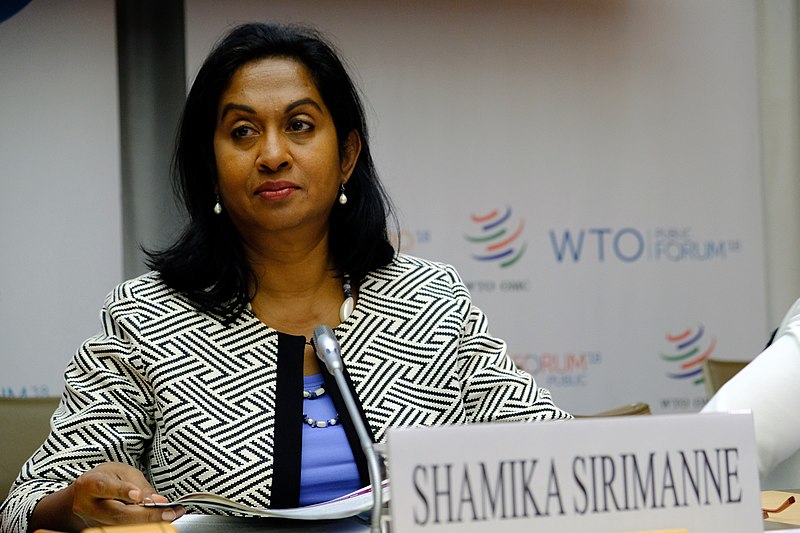
  • Ms. Shamika Sirimanne, Director, Division on Technology and Logistics, UNCTAD 
  • Ms. Xiaolan Fu, Founding Director of the Technology and Management Centre for Development (TMCD), Oxford University. UK 
  • Mr. Brighton Kaoma, the Global Director of the United Nations Sustainable Development Solutions Network
  • Discussant Dr. Stuart Krusell, Senior Director, MIT Sloan Global Programs 
  • Discussant: Ms. Salome Guchu, Principal Innovation and Outreach Officer; InterUniversity Council for East Africa
  • Discussant: Dr. Thulani Dlamini, CEO, Council for Scientific and Industrial Research, South Africa

Closing and the way forward

Summary of key initiatives and call for more supports: 
Thematic Session 1: Prof Clapperton Chakanetsa Mavhunga, MIT Thematic Session 2: Dr Marlene Kanga AO, former President (2017-2019), World Federation of Engineering Organizations (WFEO) Thematic Session 3: Professor Nkem Khumbah, Chairman, Africa Development Futures Group (ADFG) 

Key partners’ potential contributions: 
  • Mr. Alfred Watkins, Founder and CEO, Global Solutions Summit 
  • Prof. Guo Huadong, Director-General of the International Research Center of Big Data for Sustainable Development Goals (CBAS), China 
  • Mr. Alessandro Rainoldi, Head of Territorial Development Unit, Joint Research Centre, European Commission
  • Mr. Jean-Pierre Cayol, Departmental Programme Coordinator, Department of Nuclear Sciences and Applications, IAEA 
  1. Launch of partnerships for Origin Hub and the Alliance of Entrepreneurial Universities in Africa 
  2. Launch the STI for Africa Coalition - Platform for sharing technology solutions and advancing STI partnerships 

Transcript presentation Ms. Shamika Sirimanne (UNCTAD) @18:00:00

Ms. Shamika Sirimanne, Director, Division on Technology and Logistics, UNCTAD presented the finding of the report:
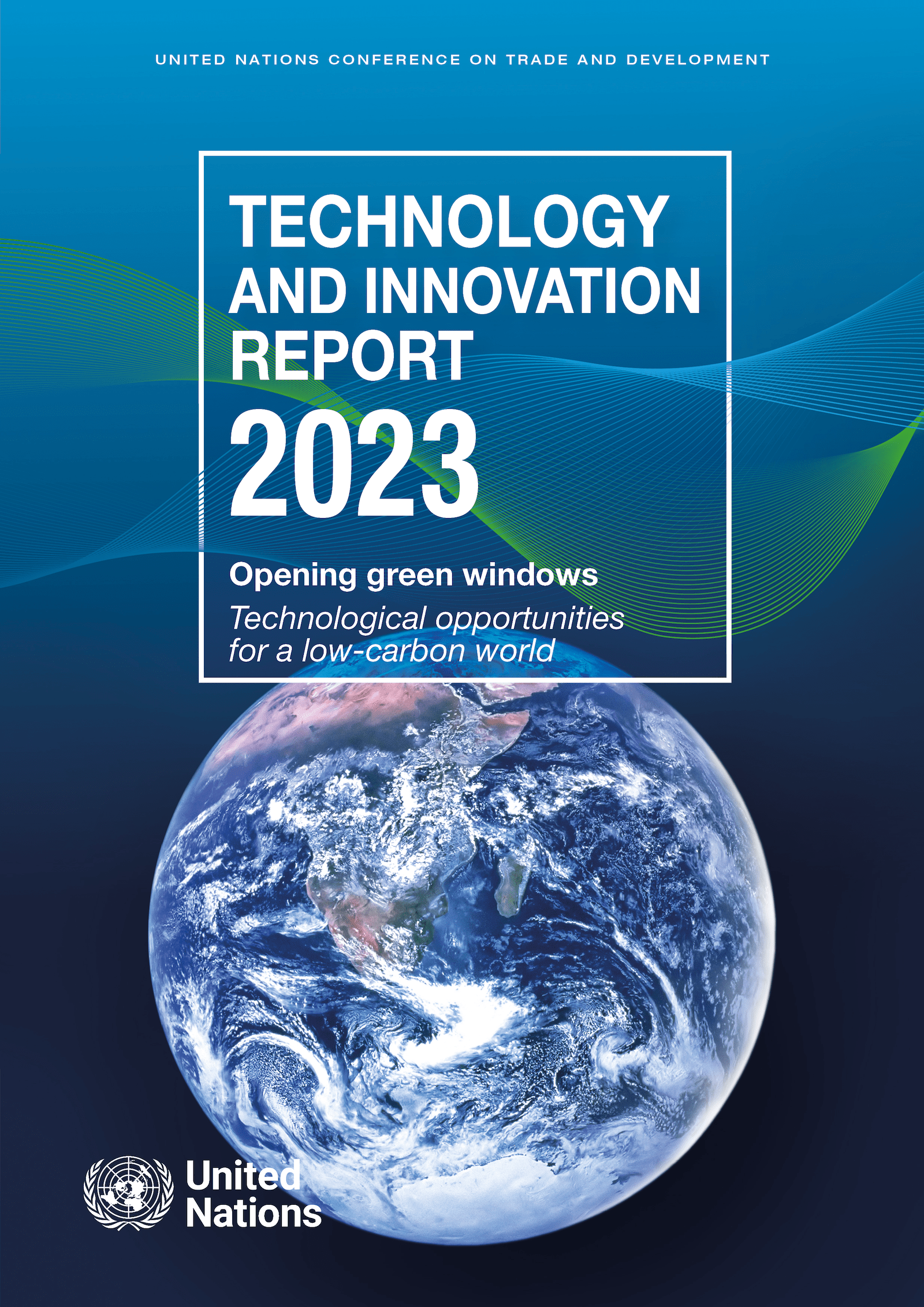
The technology and innovation report 2023 analyzed 17 frontier technologies, and these include artificial intelligence, Internet of Things and green frontier technologies such as green hydrogen electric vehicles, and so forth. And these technologies present a 1.5 trillion US dollar market today.

In the our report we say Africa possesses the world's greatest renewable energy capacity potential, estimated to reach about 310 gigawatts by 2030. And how do we realize this potential? So it's extremely important. Sometimes we don't realize it, because we have been told by many, [even] the Washington consensus, that the private sector will take care of the economy. 

What we find in our report is that governments have a very big role to play to create the enabling environment to adopt and adapt these frontier technologies. The vision and government approach to tackle technological revolution, especially in partnership with private sector seem to have given big results. It's extremely to provide basic infrastructure skills, R&D and industrial capacity and this all will be done by the government.

ICT infrastructure is critical. We are going through a technological revolution. And access to connectivity is no longer a luxury. It's basically a right but only one in four in least developed countries have access to internet and this is a concern. 

The private sector and finance will follow suit, if the enabling environment is there. What we find is that the private sector especially in developing countries will not lead if there is no enabling environment, especially in these new technological areas. They will not go into green technologies and AI and whatnot. If the enabling environment is not there the banks will not lend. Banks do not lend to young people who have this amazing idea of some digital startup. This is the reality. And banks would rather lend to retail, because that's something they understand. 

We identified several good practices:  Namibia with regard to green hydrogen; Kenya with regard to solar Photovoltaics (PVS), Ethiopia: biofuels.  All happened when the governments and private sector work hand in hand. 

Last point is that there's an urgent need to create the African voice in multilateral spaces where international trade and international and the intellectual property frameworks are negotiated, especially in the green technologies, and this could be a real bottleneck. We need to ensure that these green technologies are available for developing countries in Africa

(...) A less stringent intellectual property regime at the global level is needed urgently to support less technologically advanced countries to benefit from green technologies. Can we have flexibilities built into international IP regimes as we are struggling with the climate change? 

There there is enormous potential for Africa to benefit from Green frontier technologies. Most of the technologies needed to promote economic growth, diversification and green production are already here. We need the political will of the international community, especially those who own green technologies to support Africa, to build a more inclusive and sustainable development.


Transcript presentation Mr. Alessandro Rainoldi (JRC/European Commission) @ 2:14:20

Mr. Rainoldi leads a team of researchers and experts in the Territorial Development Unit, which is responsible for providing scientific and technical support to European policies related to regional development, urban-rural linkages, and territorial cohesion. The unit conducts research and analysis on topics such as regional innovation, smart specialization, and sustainable development, and provides policy advice to European institutions and member states.

Mr. Rainoldi discussed the role of science, technology, and innovation in promoting sustainable development and regional integration in Africa.

Science, technology and innovation (STI) can indeed be considered as generally enablers for the achievement of the SDGs. STI can deploy a wealth of solutions that are different with regard to the countries, the context, the sectors and actors: government, private sector, research organizations, but also local communities. 

Africa is probably the continent where the impact chain from STI enablers to SDGs is the shortest in the sense that innovative solutions most directly can impact on the achievement of the SDGs (...) 

The European Commission has a long story and tradition in supporting the development of African countries, but has recent experience in working specifically on STI for SDGs. 

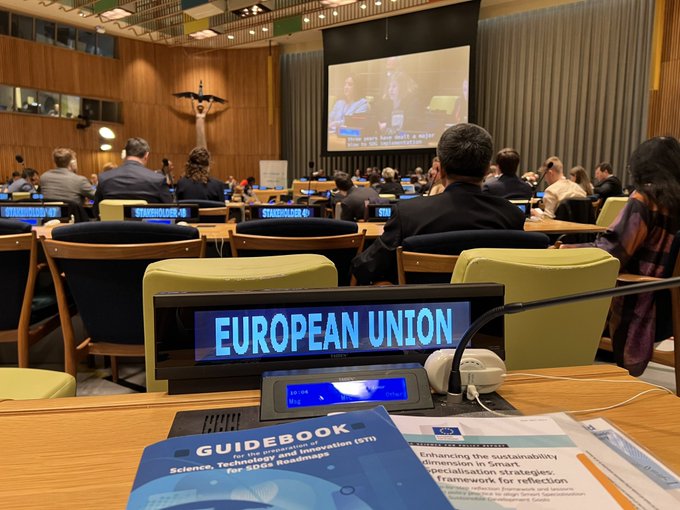
We have extensively worked together with UN DESA and a number of UN agencies in the last few years on the Guidebook for the deployment of STI for SDGs roadmaps and a number of underpinning
evidence and scientific contributions.
United Nations Inter-Agency Task Team on Science, Technology and Innovation for the SDGs and European Commission, Joint Research Centre (2021) Guidebook for the Preparation of Science, Technology and Innovation (STI) for SDGs Roadmap #124 p.

But our contribution is not only on paper, documents and analysis. It's also on projects. We have recently launched an initiative that aims at accompanying a number of African countries in the deployment of STI for SDGs roadmaps. We're working now with with six pilot countries in Sub Saharan Africa: the Gambia, Malawi, Mauritius, Namibia, Rwanda, Seychelles and also with Tunisia.
  • With the deployment of STI for SDGs roadmaps, individual countries can identify their most promising potentials for innovation for Science and Technology. (...) Through STI for SDGs roadmaps donors can identify their most promising project portfolios or initiatives for support.
  • We work specifically on the methodological side putting together evidence and data to underpin the identification of STI for SDGs priorities on scientific Economic Innovation potentials, but also with tacit knowledge, that is embedded into communities, that act into the STI ecosystems. 
  • We believe that combination of knowledge coming from data and knowledge coming from people is an essential part of and the best way to identify those potentials that can trigger STI towards the achievement of the SDGs. 
  • Our project is embedded into the newborn African Union - European Union innovation agenda, as well as in the European Union effort on what we call the Global Gateway, which is a new way to interpret, design and implement Cooperation and Development aid.
  • The European Union has a long experience in supporting the development of its own most deprived or most disadvantaged regions. This [experience] could be fruitfully used in adding the sub national flavor into the STI for SDGs approach, helping mobilize all available resources that territories and countries have, [as well as] human resources, skills, innovative potentials, that are located not necessarily in the innovation hubs of single countries but generally speaking in local communities in mid-sized cities, in actors that are sometimes not particularly connected with capital cities, but deserve to be considered as potential for development and potential for again, deploying  STI for SDGs.
We are looking forward to the Coalition for STI in Africa. And we'll be we'll be pleased to pursue further discussions with UN DESA.

Background STI for Africa Coalition

The STI for Africa Coalition is a platform that aims to promote science, technology, and innovation (STI) partnerships between African countries and other stakeholders such as international organizations, private sector, and academia. 
  • The coalition was launched in 2021 by the African Union Commission, the United Nations Economic Commission for Africa, the African Development Bank, and the World Intellectual Property Organization.
  • The platform aims to promote the sharing of technology solutions and best practices among African countries, as well as with international partners. The coalition seeks to create an enabling environment for STI in Africa by promoting policies that incentivize innovation and technology transfer, building capacity for research and development, and creating opportunities for knowledge sharing and technology transfer.
  • The STI for Africa Coalition brings together a diverse range of stakeholders, including government agencies, research institutions, universities, private sector companies, and civil society organizations. Through partnerships and collaboration, the coalition aims to promote sustainable development and economic growth in Africa through the use of science, technology, and innovation.
  • Overall, the STI for Africa Coalition serves as a platform for stakeholders to share knowledge, build networks, and promote STI partnerships that can help African countries leverage technology and innovation to address their unique challenges and opportunities.

Background: Strengthening STI Systems for Sustainable Development in Africa


The "Strengthening STI Systems for Sustainable Development in Africa" project is an initiative within
UNESCO’s global framework for monitoring, policy support and advocacy for the UNESCO Recommendation on Science and Scientific Researchers (RS|SR)
  • Funded by the Swedish International Development Cooperation Agency (Sida)(, this initiative aims to ensure that governments and national science institutions in six African pilot countries (Congo, Ghana, Namibia, Sierra Leone, Tanzania and Zimbabwe) are taking measures to strengthen their national and regional STI policies, governance of STI, and institutions in research and innovation in accordance with the RS|SR.
  • Africa-wide advocacy for the RS|SR will ensure that benefits also extend beyond the six pilot countries and lessons learnt on good practices of coalition of scientific collaboration in response to the SDGs are shared.
  • In the African context, the RS|SR offers a comprehensive, up-to-date and highly relevant statement on how the institutional organization of science relates to the intrinsic values of science, the rights and responsibilities of scientists and scientific researchers, and to the role of STI systems in achieving national development objectives.
  • The project's objective is to support action in six African countries tobenchmark STI systems against the RS|SR, strengthen capacities to design policy responses in national priority areas and to monitor progress, and establish a community of practice to underpin sustainable STI strengthening.

Background: Origin Hub 

Origin Initiative, a physical hub in East Africa has been launched by the Economic Commission for Africa (ECA) at the 5th African Science, Technology and Innovation Forum 2023 in Niemey, Niger.
  • The initiative aims to provide guidance for implementing original research and innovation labs, and organizational arrangements for entrepreneurial universities in Africa.
  • The initiative will work in three core areas that include inventing, co-creating/co-innovation, and solving complex problems for Africa, with a focus on Agri-tech, Information and Communication Technology (ICT), and Design.

Background: Alliance of Entrepreneurial Universities in Africa

This project promotes of entrepreneurial thinking, teaching and acting at partner universities. Also institutional changes in the structures and offerings of the participating institutions are supposed to act as key indicators for the development towards “entrepreneurial universities”.
  • The pilot programme used a self-assessment tool for entrepreneurial universities, developed jointly by the European Commission (EC) and the(OECD: HEInnovate to identify strengths and weaknesses with regard to qualifying as “entrepreneurial universities”.
  • The project inauguration in Kenya took place in July 2018, while the Call for Applications for Tunisia and Morocco was announced in June 2018, with the implementation phase commenced in May 2019. 
  • See the presentation: Entrepreneurial Universities in Africa

Recording part 1:


Recording part 2


Technology and Innovation Report 2023

UNCTAD (2023) The Technology and Innovation Report 2023. Opening Green Windows: Technological opportunities for a low-carbon world # 236 p.

UNCTAD (2023) The Technology and Innovation Report 2023. Opening Green Windows: Technological opportunities for a low-carbon world OVERVIEW # 23 p.

This report highlights the opportunities that green innovation – goods and services with smaller carbon footprints – offer developing countries to spur economic growth and enhance technological capacities.

The report analyses the market size of 17 green and frontier technologies, such as artificial intelligence, the Internet of Things and electric vehicles, and their potential to create jobs.

Now is the time for developing countries to capture more of the value being created in this green tech revolution – and use it to grow their economies, make them more resilient to shocks and reduce inequalities.

UNCTAD calls on their governments and business communities to invest in more complex and greener sectors, boost technical skills and scale up investments in the technology infrastructure needed to grow green industries.

To support this evolution, the report urges the international community to make global trade rules more supportive of emerging green industries in developing economies and reform intellectual property rights to facilitate technology transfer to these countries.

The report provides several recommendations for African countries to leverage technology and innovation to achieve a low-carbon economy. Some of the main recommendations are:
  • Building innovation capacity: African countries should prioritize building their innovation capacity to facilitate the development and diffusion of low-carbon technologies. This includes investing in research and development, building partnerships between industry and academia, and supporting technology transfer.
  • Strengthening policy frameworks: African countries should strengthen their policy frameworks to incentivize the use of low-carbon technologies and promote sustainable consumption and production. This includes promoting green procurement policies, implementing carbon pricing mechanisms, and creating regulatory frameworks that encourage the adoption of low-carbon technologies.
  • Mobilizing finance: African countries should mobilize finance to support the development and diffusion of low-carbon technologies. This can be achieved through public and private sector financing, international development assistance, and innovative financing mechanisms such as green bonds and impact investment.
  • Addressing technology gaps: African countries should prioritize addressing technology gaps by building local innovation capacity and facilitating access to international markets for low-carbon technologies. This includes promoting technology transfer and building partnerships with international organizations and developed countries.
  • Promoting sustainable agriculture: African countries should promote sustainable agriculture practices to reduce the carbon footprint of agriculture and promote food security. This includes promoting climate-smart agriculture practices, such as conservation agriculture and agroforestry, and investing in sustainable irrigation systems.
Overall, these recommendations are intended to help African countries leverage technology and innovation to achieve a low-carbon economy, promote sustainable development, and address the unique challenges faced by the continent.

Background documents:

Guidebook for the Preparation of Science, Technology and Innovation (STI) for SDGs Roadmap

United Nations Inter-Agency Task Team on Science, Technology and Innovation for the SDGs and European Commission, Joint Research Centre (2021) Guidebook for the Preparation of Science, Technology and Innovation (STI) for SDGs Roadmap #124 p.

This Guidebook is intended for interested national and local governments, agencies and institutions that wish to use roadmaps as a policy tool to harness STI as a means to achieve the SDGs. 

It is a comprehensive resource developed by the United Nations Development Programme (UNDP) to help countries integrate science, technology, and innovation (STI) into their national strategies for achieving the Sustainable Development Goals (SDGs).

The guidebook provides a step-by-step approach to developing an STI roadmap, including identifying priorities and setting targets, mobilizing stakeholders, assessing policy options, and monitoring progress. It also includes case studies and practical examples from different countries to demonstrate how STI can be harnessed to achieve the SDGs. Overall, the guidebook aims to help countries leverage the power of STI to accelerate progress towards sustainable development.

It may also be of interest to stakeholders taking part in the dialogue – an essential stage in design, implementation, monitoring and adjustment of the STI for SDGs Roadmaps – and to a wider public audience wishing to advance global and national SDG agendas. 

It provides several recommendations for African countries to integrate STI into their national strategies for achieving the SDGs. Some of the specific recommendations include:

  1. Building capacity for STI: African countries should invest in building human and institutional capacity for STI, including education and training programs, research and development facilities, and technology transfer initiatives.
  2. Fostering innovation ecosystems: African countries should create conducive environments for innovation, including incubation hubs, science parks, and venture capital networks. They should also promote collaboration between academia, industry, and government to facilitate knowledge sharing and technology transfer.
  3. Strengthening STI policy frameworks: African countries should develop and implement comprehensive STI policies that are aligned with their national development goals and the SDGs. They should also establish effective regulatory frameworks to support the commercialization and diffusion of new technologies.
  4. Mobilizing financial resources: African countries should mobilize financial resources to support STI initiatives, including public and private sector funding, international development assistance, and innovative financing mechanisms such as impact investment and social bonds.
  5. Promoting gender equality and social inclusion: African countries should promote gender equality and social inclusion in their STI strategies, ensuring that women and marginalized groups have equal access to education, training, and employment opportunities in STI-related fields.
Overall, these recommendations are intended to help African countries leverage the potential of STI to accelerate progress towards the SDGs and achieve sustainable development.

Tuesday, May 2, 2023

Recordings April 2023

Food Systems

  • At this event, the International Panel of Experts on Sustainable Food Systems (IPES-Food) launched a new publication: Who’s Tipping the Scales?. They shared their findings on the power imbalances that challenge democratic decision-making on food, and propose transformative governance reforms needed to address them.
  • IPES (2023) Who’s Tipping the Scales? Rebalancing power for democratic food system governance #44 p.
13 April 2023. Global Food Policy Report launch Recording available
  • IFPRI’s 2023 Global Food Policy Report, explores evidence-based policy and governance solutions that can provide better early warning and rapid response, and increase resilience of food systems
11 April 2023. Science and innovation for food systems transformation – Follow-up to the 2021 UN Food Systems Summit Recording available
  • This Open Access book compiles the findings of the Scientific Group of the United Nations Food Systems Summit 2021 and its research partners. 
  • The Scientific Group was an independent group of 28 food systems scientists from all over the world with a mandate from the Deputy Secretary-General of the United Nations.
4 - 5 April 2023. Kenya Food Systems Conference Recording available
  • The CGIAR Research Initiative on National Policies and Strategies for Food, Land, and Water Systems Transformation (NPS)
  • The conference provided evidence-based recommendations, developed by Kenyan researchers with the support of their international counterparts, to policy- and decision-makers. In addition, a matchmaking “marketplace” brought CGIAR Research Initiatives and their Kenyan research partners together with Kenyan policymakers and decision-makers to identify current and future research demand and explore how research can better provide timely information.

Agroecology


17 April 2023. InfoPoint conference: Should agriculture be intensified in the name of the environment? Recording available
  • The NGOs Iles de Paix, SOS-Faim and Autre Terre launched a study on the limitations of land sparing for the environment and for food security and nutrition. 
11 April 2023. Fungi and the Soil Food Web Recording available
  • Every organism in a healthy and thriving soil ecosystem is important, including bacteria, protozoa, and nematodes. 
  • This webinar focused on plants and fungi, because they have unique roles and partnerships that facilitate every other form of life in the soil.

Digital Agriculture


27 April 2023. Leveraging Artificial Intelligence (AI) & Satellite Remote Sensing Data for Decision-making in the African Agricultural Sector Recording available
  • AKADEMIYA2063 developed Africa Agriculture Watch (AAgWa)
  • Launched in 2021, AAgWa is a web-based platform that employs cutting-edge machine learning techniques and satellite remotely sensed data to predict agricultural yields and production levels of several crops across Africa to support decision making, monitoring, crisis management, and effective intervention planning in local communities.

27 April 2023. Digitizing Management of Indicators and Results Frameworks - Lessons Learned Recording available
  • A growing number of humanitarian and international development organizations have been shifting their processes for managing project/program results frameworks, indicators, targets, and results from spreadsheets to online platforms.

Agribusiness


25 April 2023. The Liberia Agribusiness Incubator Recording available