22 - 24 April 2024. 4th AERAP Africa-Europe Science Collaboration Forum.The Forum’s core objective is leveraging digital technologies to extend the scope of scientific collaboration and ensure inclusive participation across Africa. The agenda includes discussions on significant policy frameworks and strategic plans, such as the AU-EU Innovation Agenda, the AUC Digital Transformation Strategy for Africa (2020-2030), the EU Comprehensive Strategy with Africa, and key programmes and instruments, including Horizon Europe, FP10 and the Neighbourhood, Development and International Cooperation Instrument (NDICI). These dialogues aim to bolster sustainable development, healthcare, biodiversity, and digital advancements, resonating with the collaborative and unified approach foundational to Team Europe.
SOILL-Startup is the first in a series of support schemes for the implementation of the ambitious objectives of the Horizon Europe Mission ‘A Soil Deal for Europe’ which aims to establish 100 Soil Health Living Labs and Lighthouses (SHLLs/LHs).
The SOILL-Startup will run in 2024-2025 and aims to support and empower a growing soil health community in Europe. To this end, SOILL-Startup will provide practical support to local and regional stakeholders and capitalise learning from LLs and LHs already established. In a second phase, from 2026-2030,
SOILL will pave the way for scaling up the initiative and widening the community in the forthcoming years.
The project will set up and run an effective and transdisciplinary one-stop-shop to coordinate, support, enlarge and promote the network of 100 Soil Mission Living Labs and Lighthouses to lead the transition towards healthy soils across different settings, geographical and socio-economic contexts all over Europe.
24/04 Connecting Global Priorities: How to Build a Sustainable Long-term African-European Partnership for Renewable Energies?
Sigfried Tivana – Department of Science and Technology, South Africa
Effective delivery of innovative science and technology solutions to reinforce the 2030 Agenda for Sustainable Development and Agenda 2063, and to eradicate poverty in Africa
The Sixth African Science, Technology and Innovation Forum (ARSTIF) was held from in Addis Ababa, Ethiopia. The ARSTI Forum reviews SDGs selected the High-Level Political Forum (HLPF) which for 2024 will include Goal 1 (Poverty), Goal 2 (Hunger), Goal 13 (Climate Change), Goal 16 (Peace, Justice and Strong Institutions) and Goal 17 (Partnership for the Goals) and the corresponding goals of Agenda 2063.
The theme of the sixth African Science, Technology and Innovation Forum was “Effective delivery of science, technology and innovation solutions to reinforce the 2030 Agenda for Sustainable Development and Agenda 2063, and eradicate poverty in Africa”.
21/04 Policy dialogue on building inclusive, effective and accountable institutions in
the fields of science, technology and innovation (Goal 16) for integrated climate
action (Goal 13) in Africa
This session looked at how Africa can build inclusive, effective and accountable STI
institutions that can tackle the challenges posed by climate change. How can our
traditional hierarchical institutions be transformed to create open spaces for debating,
sharing views, asking questions and for continuous searching for solutions to climate
change? How and where should Africa direct its human capital development, and
investment in R&D, innovation, entrepreneurship and industry to make major
contributions in addressing climate change to achieve sustainable development? What are
the emerging practices, evidence and solutions that can be scaled up in Africa?
Moderator: Inter-regional advisor, UNECA, Frank Rutabingwa
Future Earth Africa Hub Leadership Centre, University of Pretoria, Dr.
Daniel Nyanganyura.
CEO - Research and Community Engagement Affairs, Ministry of Education,
Ethiopia, Dr. Solomon Benor,
President, African Materials Research Society, Senegal, Professor Balla Diop
Ngom
Director, Science and Technology Policy Research Institute, Ghana, Dr.
Wilhemina Quaye
Research and Policy Officer, South Africa Climate Action Network,
Moliehi Mafantiri
21/04 High-level policy dialogue on building capacity in science, technology and innovation to eradicate poverty (Goal 1) and hunger (Goal 2)
This session explored elements that have kept both the number of poor and hungry
people in Africa high; measures to address food availability, accessibility and businesses
that create real paying jobs to create wealth; the potential rise of agro-processing
industries as well as inputs (e.g. fertilizer, animal feed, energy producers) in reducing
production costs and diversifying exports among other policy measures. It also
addressed the importance of human capital development, knowledge and innovation in
meeting both goals.
Moderator: Coordinator, African Materials Research Society, Samuel Chigome
Minister of Agriculture, Ethiopia, Hon. Ato Girma Amente
Minister of Planning and Development, Ethiopia, Hon. Dr Fitsum Assefa Adela
Director, Multilateral Cooperation and Africa, Department of Science and Innovation, South Africa, Mandry Ntshani
Government Affairs and Public Policy, Public Affairs Manager, Google SSA, Alex Nyingi
Senior Private Development Sector Specialist, World Bank, Alejandro Espinosa-Wang,
President, State University of New York Polytechnic Institute, United States, and Founder, African Materials Research Society, Prof. Winston Oluwole Soboyejo virtual
Director AU Global Office and Representative to the AUC and UNECA, WFP, Dr Hameed Nuru
Director of East and Southern Africa, IFAD, Ms. Sara Mbago-Bhunu (Virtual)
Director for East and Southern Africa, UNFPA, Ms. Lydia Zigomo (virtual)
SDG Integration Advisor for the African Region, UNDP, Dr Frederick Mugisha
22/04 Policy dialogue on using the African Continental Free Trade Area as a
springboard for the development of science, technology and innovation. Video @07:02:03
This policy dialogue addressed, among others, the role science and innovation is
or should play in the operational phase of the AfCFTA; determine what policy
interventions are required, especially at regional and national levels to unlock the
opportunities presented by the operationalization phase for STI; and unpack at a
practical level how different aspects of the operationalization phase may be
monitored.
Moderator: Director Africa Multilateral Cooperation, Department of Science and
Innovation, South Africa Ms Mandry Ntshani
South African Research Chair in Industrial Development, University of
Johannesburg, South Africa, Professor Fiona Tregenna (Online)
Trade Attaché (Counsellor) and Senior Trade Negotiator to the AfCFTA, Embassy
of the Republic of Angola in Accra, Ghana, Mr Rui Livramento (Online)
Head, Science, Technology and Innovation Policy and Partnerships, African
Academy of Sciences, Kenya, Nkem Khumbah
Portfolio Manager, Technology Innovation Agency, South Africa, Dr Tozamile
Rubuluza
Chief Scientific Officer, Tokabio, South Africa, Dr Phiyani Lebea
22/04 Leveraging the International Decade of Sciences for Sustainable
Development to promote science, technology and innovation in Africa
The session discussed strategies for strengthening STI education, training, and
research infrastructure in Africa to build a skilled workforce and promote
ECA/STIF/2024/INF/2
8/11
knowledge creation and dissemination; explore initiatives to support the growth
of innovation ecosystems in Africa, including incubators, accelerators, and
technology parks, to foster entrepreneurship, technology transfer, and
collaboration between academia, industry, and government; identify priority
areas for STI intervention to address key societal challenges in Africa, such as
healthcare, agriculture, energy, and environmental sustainability and discuss
innovative solutions and partnerships to drive impact at scale; examine the role
of digital technologies, including artificial intelligence, big data, and blockchain
in accelerating STI and promoting inclusive development in Africa; and discuss
strategies for harnessing the potential of digital innovation
Moderator: Chief of Basic Sciences, Research Innovation, and
Engineering Section, Natural Sciences Sector, UNESCO, Ms Amal Kasry
Keynote speaker:
President of UNESCO General Conference, H.E. Amb. Simona-Mirela
Miculescu
Assistant Director-General for Natural Sciences (UNESCO), Lidia Brito
Executive Director, African Academy of Science, Kenya, Dr Peggy OtiBoateng (online)
Chinese Academy of Science and Technology for Development,
Secretariat, International Research and Training Center for Science
and Technology Strategy under the Auspices of UNESCO
(CISTRAT), Dr. Yang Jing
Director, Future Africa and Strategic Advisor on Transdisciplinarity
and Global Knowledge Networks, University of Pretoria (tbc),
Heide Hackmann (online)
Member of the Steering Group of the Earth-Humanity Coalition, Professor of Earth Politics, Faculty of Humanities, University of Cape
Town, Prof. Lesley Green
Manager, Emerging Markets Public Affairs, Google, Alex Nyingi
Scientific Research Advisor to the Minister of Higher Education,
Scientific Research and Technological Innovation, Republic of the
Congo, Gabin Dimitri Ngantso, (tentative)
22/04 Partnership in Action: Closing Funding Gaps to Accelerate Sustainable
Development, the African Union-European Union Innovation Agenda
Co-chair: EU Delegation to the African Union, Dr Laurent Bochereau,
General scene-setting: The AU-EU Innovation Agenda
Commissioner for Education, Science, Technology & Innovation, African
Union Commission, H.E. Prof Mohamed Belhocine
Sub session 1: How can STI4SDGs roadmaps help to mobilise and effectively
guide STI investments decisions towards the most pressing SDGs?
Introduction: Team Leader, Joint Research Centre, European Commission, Dr
Angela Sarcina,
Assistant Director-General for Natural Sciences, United Nations Educational,
Scientific and Cultural Organization (UNESCO), Ms Lidia Arthur Brito
Director Science and Technology Policy Research Institute, Republic of Ghana,
Dr. Wilhemina Quaye
Head of Science, Technology Development and Outreach Department at
National Council for Science and Technology (NCST), Republic of Rwanda, Mr
Louis Sibomana
Director General, Division of Science, Technology and Innovation, Ministry of
Investment, Entrepreneurship and Industry, Republic of Seychelles, Ms Cynthia
Alexander
Director of the Transformative Innovation Africa Hub (TIAH), University of
Pretoria; Director of the Africa Transformative Innovation Policy Consortium
(TIPC) at the University of Sussex Science Policy Research Unit (SPRU), Mr
Daniel Chux
Moderator: Scientific Affairs Officer, United Nations Economic Commission for
Africa (UNECA), Dr Victor Konde,
Sub session 2: How can the Innovation-Agenda help innovators access
finance and grow their activities faster and in a more sustainable way?
Introduction: Director for Africa Multilateral Cooperation at the Department
of Science and Innovation, Republic of South Africa, Ms Mandry Ntshani,
Officer at ENRICH in Africa, Ms Mélanie Mwangi.
Founder of Angular Creative Labs, Mr Thato Kasongo,
Founder of Mawejje Creations, Mr Dimma Mawejje Muhammed,
Founder of YEWGlobal & ELO Petroleum, Ms Edma Lawer,
Founder and CEO minoHealth AI Labs, karaAgro AI, Runmila AI Institute,
Gudra AI Studio, Mr Darlington Akogo
Co-founder of BACE Group, Ms Charlette N’Guessan,
Moderator: Expert for GMES & Africa Program African Union
Commission, Dr Taibou Ba
Sub session 3: How can innovation funders mobilise the AU-EU
Innovation Agenda to identify bankable and truly innovative projects?
Introduction: Director of Science Technology and Innovation in the National
Council for Scientific Research and Technologies (CNRST), the People's
Democratic Republic of Algeria, Prof Mokhtar Sellami,
Founder of VC4A, Mr Ben White,
VC4A is the leading platform supporting entrepreneurs, mentors, investors and business professionals, strengthening the startup community in Africa, Latin America and beyond.
He mentioned the African Early stage investors summit 2024 (November Cape Town South Africa)
Advisor on Economic Integration, Office of the Secretary, General of the
African Continental Free Trade Area, Dr Francis Mangeni
Country Director to Ethiopia and AU, KfW Development Bank, Mr Jonas
Dylla
Co-Founder of Villgro Africa, Dr Robert Karanja
Moderator: Science Counsellor at the Swedish Embassy in Addis, Dr
Amina Jama
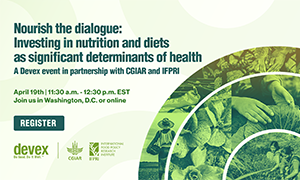
Produced by Devex in partnership with CGIAR and IFPRI
This session will convene nutrition and climate experts to discuss the vital role of healthy diets; showcase a suite of proven solutions across the agrifood value chain for improving diets in low- and middle-income countries; and examine how best to scale these solutions so that everyone can reap the benefits of sustainable healthy diets.
Fireside chat: The importance of healthy and sustainable diets
Henrietta H. Fore, former Executive Director of UNICEF, former USAID Administrator and CEO & Chairman, Holsman International
The 33rd Session of the Regional Conference for Africa (ARC33) put a spotlight on the FAO Strategic Framework 2022-2031 and the four betters: better production, better nutrition, a better environment, and a better life, leaving no one behind.
The conference theme was Resilient agrifood systems and inclusive rural transformation.
Foresight analysis: Drivers and triggers of agrifood systems transformation in Africa
By analysing emerging technologies, climate resilience strategies, market dynamics and
cultural influences, the discussion provided insights into plausible futures for agrifood systems.
Emphasis was placed on the transformative potential of youth and women empowerment and the role of
effective policies in guiding positive change.
Blue Transformation in Africa: The potential of aquatic foods
The potential of aquatic foods underscores the
pivotal role of aquatic resources in reshaping the continent's economic and nutritional landscape.
Inclusive rural transformation in Africa: Agriculture mechanization, digitalization, women
and youth
Public-private partnerships were highlighted as key enablers of inclusive rural transformation, ultimately
empowering communities through a holistic approach. The roadmap includes replicable models and
strategies to achieve sustainable development, ensuring that no one is left behind in Africa's journey
towards inclusive rural transformation.
Decisions of the United Nations Conference of Parties to Climate Change, Biological Diversity
and Combat Desertification
The
presentations underscored the importance of indigenous knowledge, robust monitoring mechanisms and
financial strategies to facilitate coordinated action.
Agrifood systems transformation in Small Island Developing States, Least Developed
Countries and Landlocked Developing Countries
By delving into the current state, challenges and
opportunities, the discussion shed light on sustainable solutions tailored to these regions.
Livestock Development Strategy in Africa
The Livestock Development Strategy in Africa (with the AU–Inter-African Bureau for Animal
Resources [AU-IBAR]) aims to transform the continent's livestock sector into a resilient and
sustainable contributor to food security and economic growth.
Financing resilient agrifood systems and inclusive rural transformation: Boosting public and
private sector investment
By exploring investment opportunities, blended finance models,
and inclusive financial instruments, the discussion emphasized the collaborative efforts of the public
and private sectors. The presentation showcased case studies and success stories, providing tangible
evidence of the positive impact of such investments. A roadmap for sustainable financing concluded the presentation, outlining actionable steps for creating an enabling environment that fosters resilience
and inclusivity in Africa's agrifood systems.
Members’ experience-sharing on the four betters and initiatives
This was a dedicated session allocated for experience-sharing among Members on better production,
better nutrition, a better environment, and a better life, leaving no one behind.
The Regional Hand-in-Hand Initiative Investment
Forum dialogue with partners
The Regional Hand-in-Hand Initiative Investment Forum dialogue with partners aims to catalyse
economic growth in Africa through private sector engagement and strategic partnerships. Focused on
key sectors and investment opportunities, the forum explored government policies, showcase
successful collaborations and present case studies to inspire actionable insights. The Investment Forum served as a
milestone in the ongoing commitment to the Hand-in-Hand Initiative, fostering a collaborative
approach to shape the future of Africa's economic landscape
Risk Assessment for Israel Agriculture and Adaptation to Climate
Yael Kachel, Senior Economist - Strategy DivisionSenior Economist - Strategy Division. Ministry of Agriculture and Rural Development, Israel - How to Transform Agriculture in The Era of Climate Change – The Role of Government
Marc Perel, Agriculture Meteorologist and co-cordinator of the Agricultural Preparation Committee on Climate Change, Soil Conservation & Drainage Unit Ministry of Agriculture and Rural Development - Risk Assessment for Israel Agriculture and Adaptation to Climate
The climate crisis is one of the biggest threats to the global economy and to human wellbeing, already taking its toll and severely affecting our ecosystems, livelihoods and food security. Considered a "desert threshold" country, Israel is expected to face impactful climate changes resulting in extensive consequences for its agricultural and water sectors, among others. In view of these facts, Israel is making important steps to assist its agricultural sector in adapting to climate change, including formulating a quantitative assessment for prioritizing and targeting preparedness policies.
Head of MATC/ Ministry of Agriculture Rep. Israel - A Country on the Frontline of Climate Innovation
Ambassador Gideon Behar, Special Envoy for Climate Change Ministry of Foreign Affairs of Israel Food Farming in Light of Changing Climate: Challenges and Solutions
Dr Gidon Toperoff, co-cordinator of the Agricultural Preparation Committee on Climate Change Ministry of Agriculture and Rural Development
This conference, organised by the Belgian Federal Public Service of Foreign Affairs and Development Cooperation, the Directorate-General for Development Cooperation and Humanitarian Aid, the Food and Agriculture Organization of the United Nations (FAO), and Ghent University, is a collective effort to align with the Sustainable Development Goals, offering a unique opportunity to address interconnected global challenges.
The anticipated outcome is not just knowledge but actionable insights—a roadmap towards ensuring healthy diets and better nutrition for all.
Healthy diets for nutrition: are we making progress?
Caroline Bollars, WHO
Leonard Mizzi, Head of Unit Sustainable Agri-Food systems
and Fisheries - European Commission, International
Partnerships
Bridget Holmes, Nutrition Officer, FAO
Scaling up effective approaches and policy frameworks
Speakers:
Katharina Beelen, Rikolto, Belgium
Bridget Fenn, Nutrition Research facility
Bruno Gautrais, Head of Unit E2, DG Health and Food Safety,
Accelerating efforts and effective partnerships for healthy diets and
nutrition: what’s needed?
MSc Nutrition and Food Systems Ghent University
Antonia Potter Prentice, Director of Alliance 2015 Generation
Nutrition
Namukolo Covic, Regional Director, East and Southern Africa,
CGIAR
Josep Puxeu Rocamora, European Economic and Social
Committee (EESC) Group I — Employer's, representing the
Spanish Food and Drink Industry Federation (FIAB) and
Director-general of the Soft Drinks Association (ANFABRA)
Ambassador Brieuc Pont, Special Envoy for the Nutrition for
Growth Summit, French Ministry for Europe and Foreign Affairs - closing remarks
Prof. Carl Lachat, Ghent University - closing remarks
Global Forum for Rural Advisory Services (GFRAS) in partnership with the Southern Africa Agri Initiative (SAAI), FANRPAN and AiFarmer
Discover how advancements in artificial intelligence are revolutionizing digitalization efforts within the agricultural sector, unlocking new opportunities for enhanced advisory services and knowledge dissemination.
Gain valuable insights into leveraging AI technologies for sustainable agricultural development and improved livelihoods.
Recording forthcoming
Francois Rossouw Southern African Agricultural Initiative (SAAI) University of Pretoria/Universiteit van Pretoria
André Strauss, CEO of CohesionX the developers of AELA's AI Farmer technology. (Agricultural Extension Language Assistant)
AI Farmer, AELA’s flagship application, represents a significant leap forward in agricultural extension services. Traditional extension programs, while foundational, have faced challenges such as limited reach, especially in remote areas, language barriers, and a one-size-fits-all approach that often fails to address the specific needs of individual farmers.
AI Farmer is designed to overcome these hurdles by providing personalized, accessible, and
actionable agricultural advice through advanced AI technology.
Archana Karanam, an ICT for ARD professional and has been a vital part of Digital Green since 2009
Some key takeaways from the meeting include:
- AI can help address challenges in agricultural extension like limited access, language barriers, limited time/resources for farmers, and more by providing on-demand advice to farmers.
- Both PSI and Digital Green are working on AI platforms to deliver personalized advice to farmers through chatbots and mobile apps. They curate agricultural data and train AI models to answer farmers' questions.
- It's important to have human experts involved to ensure AI responses are accurate, unbiased, and address local farming conditions. Feedback mechanisms also help improve AI over time.
- Value chain actors beyond just producers could potentially benefit from AI extension platforms, though more work may be needed to apply them throughout supply chains.
- Localization of AI systems, including supporting many languages and addressing local terminology, is an ongoing challenge but critical for adoption.
Several studies have indicated that soil organic matter content and nutrients balance can be improved at farm level through proper agronomic practices in mixed farming systems. However, fertilizers are still needed to improve productivity. Off-farm production of safe and affordable organic fertilizers and biofertilizers could provide another pathway for soil health and productivity improvement in Africa.
However, a lack of information and knowledge exists regarding the production, marketing, and utilization of commercial organic and biofertilizers. In fact, many relevant initiatives exist involving various actors such as Farmers' Organizations, NGOs, and SMEs.
With a view to inform policy dialogue addressing the fertilizer crisis and food security challenges, DG INTPA, through DeSIRA-LIFT, commissioned a scoping study on the off-farm production and marketing of organic and biofertilizers in 12 case-study countries in Africa.
In this conference the results of the scoping study was shared and two SMEs shared their experiences regarding the potential of commercial organic and biofertilizer production and marketing.
Carla Montesi, Director INTPA F- Green Deal, Digital Agenda
Bernhard Freyer, Pierre Ellssel and Fortunate Nyakanda, Scoping Study results
Representative from Zim Earth Farms, African producer (Zimbabwe)
Representative from Safisana, African producer (Ghana)
The study address the use and acceptance of organic and biofertilizers, the potential development of these inputs, the marketing systems, the support services (research and advisory services), the national policies and regulatory framework .
Organic and biofertilisers (OFBF) demonstrate strong potential in addressing soil fertility, enhancing crop yields and contributing to the nutrient cycle in Africa.
To unlock Africa’s potential for soil health and agricultural productivity, a holistic approach is crucial.
Support to local and national initiatives on OFBF must be scaled.
Recycling organic wastes can potentially cover 20-40% of an agricultural system’s nutrient requirements.
Positive socio-economic impacts from organic fertiliser use can be realised through centralised or decentralised collection, processing and distribution systems tailored to raw material characteristics and volumes from waste streams, local circumstances and current organic fertiliser dynamics in each country.
Waste-based organic fertiliser production and use can yield various positive environmental impacts.
To overcome cultural and traditional barriers to the adoption of OFBF, initiatives of education and advisory services play a vital role.
Biofertilisers, or biostimulants, cover various products with distinct traits. Additional research is required for a comprehensive understanding and strengthening of biofertilizer impact and use at scale.
Research on OFBF and soil amendments, including biochar and liming, is highly recommended to establish an evidence base on product efficacy.
Waste management regulations exist in almost all of the case study countries. However, the subsequent application and enforcement of these regulations is lacking.
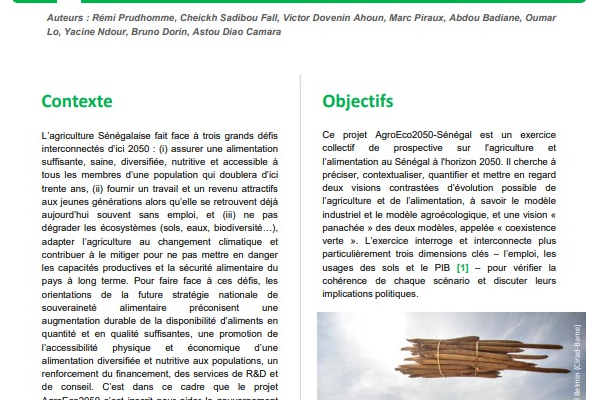
The main objective of this event was to share and discuss the main conclusions of the “AgroEco2050-Senegal” foresight exercise and its implications for sustainable agri-food systems in Senegal.
Jointly implemented by the government of Senegal, CIRAD, ISRA-BAME, FAO and DyTAES, with financial support from GIZ on behalf of BMZ, AgroEco2050-Senegal appears to be an essential initiative aimed at informing long-term visions for Senegalese agriculture.
This collective effort has engaged scientists, farmers, policymakers and institutions to shape the future. AgroEco2050-Senegal aimed to clarify and quantify two different visions of what agriculture, food, nature, employment and well-being could be in Senegal by 2050. One vision was based on intensification of conventional industrial agriculture (IA), while the other was based on scaling up of agroecology (AE). The objective was to compare and understand the implications of these two different paths and to verify their consistency.
This dynamic three-hour event brought together civil servants, researchers, representatives of civil society and the private sector, as well as stakeholders from Senegal and the international community. Through expert advice and stakeholder engagement, the event fostered dialogue, raised awareness and stimulated action towards a sustainable and prosperous agricultural landscape in Senegal.
Co-hosted by the Food and Land Use Coalition (FOLU), World Business Council for Sustainable Development (WBCSD), and We Mean Business Coalition, the event will delve into key insights from a recently published report series: ‘Future Fit Food and Agriculture’ revealing that US $205 billion per year is needed from the food sector to mitigate half of global food system emissions.
While significant, these costs are manageable for the sector as a whole as they represent less than 2% of total food sector revenues. Industry leaders will discuss the critical role companies play in addressing emissions resulting from agricultural production and land-use changes within their value chains.
Morgan Gillespy, Executive Director, Food and Land Use Coalition
Alex Andreoli, Associate, Sytemiq
Emeline Fellus - Senior Director, Agriculture and Food & Member of the WBCSD Extended Leadership Group.
Owen Bethell - Environmental Impact Lead Global Public Affairs, Nestle
Milindi Sibomana- Chief Agriculture Officer at One Acre Fund Rwanda
Luke Pritchard- Deputy Director, Nature Based Solutions, We Mean Business Coalition
Investment from the food sector of approximately US $205 billion per year between 2025 and 2030 could mitigate up to 9 GtCO2e annually by 2030.
While significant, these costs represent less than 2% of total projected food sector revenues and come with other benefits including access to new and growing markets, some on farm savings and improved supply chain resilience.
This report highlights that the burden of mitigation varies depending on where actors sit along the value chain. A critical challenge is that the costs are currently projected to land most heavily on farmers, who are the least able to pay.
Overcoming this inequity requires companies to reassess how they partner with actors in the value chain, particularly farmers, and how they engage with policymakers to accelerate action.
Businesses setting and implementing ambitious climate and nature strategies today will be better prepared for future sustainability regulation, facing fewer compliance risks and experiencing less disruption in their supply chains.
Ambitious companies can not only leverage established and emerging voluntary standards to get ahead of the game, but they can and should also seize the opportunity to advocate for harmonized standards and regulation, which will accelerate the food sector’s transition to a sustainable future.
This seminar examined Africa's climate and energy futures, shedding light on various scenarios, including the consequences of a global carbon tax and aggressive energy policies, and the transformative effects of transitioning to sustainable practices. It discussed two new reports that examine Africa’s development prospects if countries adopt sustainable energy policies.
Moderator: Ottilia Anna Maunganidze, Head, Special Projects, ISS
Panelists: Dr Jakkie Cilliers, Head, African Futures & Innovation, ISS
Alize le Roux, Senior Researcher, African Futures & Innovation, ISS
Saliem Fakir, Executive Director, African Climate Foundation
Prof Abubakar Sambo, Chairman, Nigerian Member Committee of the World Energy Council
The implementation of differentiated carbon taxes and the pursuit of the Sustainable Africa scenario could offer a path to significant emission reductions and improved economic outcomes. However, the success of these measures is contingent on the continued exploitation of gas resources to avoid energy and financial crises. Africa needs to prioritise adaptation if it wants to ensure the safety of communities and infrastructure amidst the ongoing climate crises.
Africa is experiencing a growing addiction to gas and oil. Yet, in 2023, Africa produced only 6.6% of world energy, which would increase to 8.1% in 2050 - a portion vastly out of balance with its large and growing population and development needs. Energy demand, however, in Africa is less than 5% of the world. The difference between production and demand reflects that the continent has abundant energy resources but exports a significant portion. According to the Climate Action Tracker, around 40% of Africa’s gas production is exported, primarily to Europe, China and India whilst again importing refined products.
The Africa Energy Policy scenario examines the ramifications of diminishing coal and oil productionwithout limiting gas. The analysis indicates that constraints on gas production would create an unmanageable
energy production shortfall for a continent still with very low levels of energy availability.
The scenario includes various mitigation efforts and the expansion in renewables, hydro, and nuclear power
needed to bridge the remaining energy demand gap. The scenario also incorporates carbon sequestration and
enhanced energy efficiency measures to gauge their impact on carbon emissions.
Risk Assessment for Israel Agriculture and Adaptation to Climate
Yael Kachel, Senior Economist - Strategy DivisionSenior Economist - Strategy Division. Ministry of Agriculture and Rural Development, Israel - How to Transform Agriculture in The Era of Climate Change – The Role of Government
Marc Perel, Agriculture Meteorologist and co-cordinator of the Agricultural Preparation Committee on Climate Change, Soil Conservation & Drainage Unit Ministry of Agriculture and Rural Development - Risk Assessment for Israel Agriculture and Adaptation to Climate
The climate crisis is one of the biggest threats to the global economy and to human wellbeing, already taking its toll and severely affecting our ecosystems, livelihoods and food security. Considered a "desert threshold" country, Israel is expected to face impactful climate changes resulting in extensive consequences for its agricultural and water sectors, among others. In view of these facts, Israel is making important steps to assist its agricultural sector in adapting to climate change, including formulating a quantitative assessment for prioritizing and targeting preparedness policies.
Head of MATC/ Ministry of Agriculture Rep. Israel - A Country on the Frontline of Climate Innovation
Ambassador Gideon Behar, Special Envoy for Climate Change Ministry of Foreign Affairs of Israel Food Farming in Light of Changing Climate: Challenges and Solutions
Dr Gidon Toperoff, co-cordinator of the Agricultural Preparation Committee on Climate Change Ministry of Agriculture and Rural Development