27 August 2020. 2 PM CEST/CAT. Harnessing the Power of Data for Smallholders - Data and the Path to Food Security
Platform for African – European Partnership in Agricultural Research for Development
Thursday, August 27, 2020
WEBINAR: Harnessing the Power of Data for Smallholders - Data and the Path to Food Security
27 August 2020. 2 PM CEST/CAT. Harnessing the Power of Data for Smallholders - Data and the Path to Food Security
WEBINARS: Digitalisation of Extension and Advisory Services
27 August 2020. Digitalisation of Extension and Advisory Services. AFAAS in collaboration with CTA Legacy and other partners. For more information about the D4AEAS initiative at AFAAS, view here: https://www.afaas-africa.org/d4aeas/
September 24: Digitalisation of AEAS: Framework and Practical cases
Exercises: Collection of concrete cases from countries and evaluation
October 29: Digitalisation of AEAS: Assessing e-extension solutions
Exercises: Documenting failures and successes
November 27: Foresighting e-Extension to enhance effectiveness and efficiency of Extension.
Exercises: Foresight, documentation of findings and recommendations
WEBINAR: means of finding alternatives to maize as a staple food in Kenya
26 August 2020. De-Maizing Kenya: Exploring on alternative crops for Food and Nutritional Security. Egerton University National Forum Webinar 1
Egerton University organised a virtual forum on ways and means of finding alternatives to maize as a staple food in Kenya. The event was moderated by the dean of the faculty of agriculture Prof Abdul Faraj. Chief guest was Prof Hamadi Boga, PS, Crop Development and Agricultural Research.
The institution's Vice Chancellor Prof Rose Mwonya, Dr Anthony Egeru of Ruforum and Prof Nancy Mungai from TagDev spoke during the opening session.
Key speakers
- Dr Lusike Wasilwa, a director with KALRO - the "History of maize and cropping systems in Kenya".
- Dr Timothy Njagi Tegemeo Institute - 'Comparative analysis of maize, other cereals, roots and tubers in Kenya over the last 20 years".
- Prof Agnes Mwang'ombe - "Cassava as a promising alternative crop to maize"
- Prof Anthony Kibe - "Potato as an alternative staple crop".
- Dr Gbegbelegbe Sika and Dr David Chikoye of the International Institute of Tropical Agriculture (IITA) - "Perspectives on Agro-ecological zoning of maize in Africa and technologies that IITA can provide to enhance de-maizing of Kenya".
- My Josphat Munyu from the Ministry of Agriculture - "Food Nutrition Policy: Compositing and blending of flour".
- Mr Stephen Mutoro, Secretary General of the Consumers Federation of Kenya (Cofek) - 'Consumer preferences and consumer behaviour: How to change'
- Prof Richard Mulwa amd Prof Patience Mshenga - reflections and wrap-ups of the session
Wednesday, August 26, 2020
Science of Scaling: connecting the pathways of agricultural research and development for improved food, income, and nutrition security.
- What is the science of scaling and what have we learned so far? What critical knowledge gaps are yet to be filled?
- What are the roles and responsibilities of researchers and R4D centers, and how can development and research organizations learn from each other for sustainable change at scale?
- Hayley Price-Kelly, Program Officer, Evaluation; International Development Research Centre (IDRC)
- Marc Schut, Senior Innovation and Scaling Scientist at IITA.
Edited by Marc Schut, Cees Leeuwis, Graham Thiele
Last update 7 August 2020
Tuesday, August 25, 2020
Failing Africa’s Farmers: An Impact Assessment of the Alliance for a Green Revolution in Africa
Failing Africa’s Farmers: An Impact Assessment of the Alliance for a Green Revolution in Africa.
GLOBAL DEVELOPMENT AND ENVIRONMENT INSTITUTE WORKING PAPER NO. 20-01July 2020. 38 pages.
The report is based on a study by Tufts University researchers, who say AGRA declined requests to provide internal monitoring and outcomes evaluation data. Instead, researchers used country-level production, yield and land data to assess whether AGRA programs had significantly raised agricultural productivity.
AGRA's 2017-2021 strategy states it will "contribute" to doubling the yields and incomes of 30 million smallholder households—nine million directly and 21 million indirectly.
We found no evidence that productivity, incomes or food security were increasing significantly for smallholder households. (Failing Africa’s farmers: New report shows Africa’s Green Revolution is “failing on its own terms”).
- Little evidence AGRA was reaching a significant number of farmers. Its last progress report says only that AGRA had trained 5.3 million farmers in modern practices with “1.86 million farmers using” such practices. This is vague and far short of the stated goal of doubling productivity and incomes for seven million farmers directly and another 21 million indirectly.
- No evidence of significant increases in smallholder incomes or food security. For AGRA countries as a whole, there has been a 30% increase in the number of people suffering extreme hunger since AGRA began, a condition affecting 130 million people in AGRA countries. Kenya, home to AGRA’s headquarters, saw an increase in the share of its people suffering undernourishment in the AGRA years.
- No evidence of large productivity increases. For staple crops as a whole, yields are up only 18% over 12 years for AGRA’s 13 countries. Even maize, heavily promoted by Green Revolution programs, showed just 29% yield growth, well short of AGRA’s goal of doubling productivity, which would be a 100% increase.
- Where technology adoption has taken place, input subsidies provided by African governments seem far more influential than AGRA’s programs. It is difficult to find evidence that AGRA’s programs would have any significant impacts in the absence of such large subsidies from African governments.
- Even where production increased, as in Zambia, a near-tripling of maize production did not result in reductions in rural poverty or hunger. Small-scale farmers were not benefiting; poverty and hunger remained staggeringly high with 78% of rural Zambians in extreme poverty.
- Green Revolution incentives for priority crops such as maize drove land into maize and out of more nutritious and climate-resilient traditional crops such as millet and sorghum, eroding food security and nutrition for poor farmers. Millet production declined 24% with yields falling 21% in the AGRA years.
- No signs of “sustainable intensification,” the goal of sustainably increasing production on existing farmland. Environmental impacts are negative, including acidification of soils under monoculture cultivation with fossil-fuel-based fertilizers. Production increases have come more from farmers bringing new land under cultivation — “extensification” — than from productivity increases. Both trends have implications for climate change mitigation and adaptation.
WEBINARS: Big data solutions to COVID-19 & food security
- Sara Mbago-Bhunu | Director, East and Southern Africa Division, International Fund For Agricultural Development (IFAD)
- Andy Jarvis Associate Director-General, Bioversity International and CIAT alliance and co-founder of the CGIAR Platform for Big Data in Agriculture
- Natalia Pshenichnaya Head of the AgriTech and CleanTech Programmes at GSMA
- Brian King Coordinator of the CGIAR Platform for Big Data in Agriculture
- Richard Choularton - Director of Agriculture and Economic Growth Sector, Tetra Tech
- Chiamaka Ndukwu - Founder and CEO, AgroHive
- Susan Mathew - International Trade Analyst
- Berber Kramer - Research Fellow, International Food Policy Research Institute (IFPRI)
- Madina Amin Hussein | Founder and CEO, Global Nature Conservation
- Ram Dhulipala | International Crops Research Institute for the Semi-Arid Tropics (ICRISAT)
- Jonathan Steinke | Research Fellow, Alliance of Bioversity and CIAT
- Shreya Agarwal | Director of Strategy, Digital Green
- Stephanie Dizon - Head of Implementation, FarmForce
- Aashna Singh - Co-Founder, MoooFarm
- Shahid Akbar - CEO, Bangladesh Institute of ICT Development
- Zeituna Mustafa - Market Engagement Manager, GSMA
- Christine Chege - Agri-Nutrition and Food Systems Specialist, The Alliance of Bioversity International and CIAT
- Marieke de Ruyter de Wildt - Founder, The New Fork
Some Welfare Consequences of COVID-19 in Ethiopia
Continuing the practice of sharing emerging evidence on the impact of COVID-19, findings of several studies were reported during a webinar organized by IFPRI and PSI on August 24, 2020. The presentations focus on the impact of COVID-19 on the welfare of mothers and children, food and nutrition security, food marketing margins, livelihoods, and poverty.
FAO/ITU WEBINAR: Fostering an Enabling Ecosystem for Food and Agriculture through Digital Innovation
- Introduction by Meng ZENG (Moderator) - Information Technology Officer, FAO
- Dejan Jakovljevic - Deputy Director, IT Services, FAO
- Longbao Wei – Director, Institute of Food and Agribusiness Management, Zhejiang University
- Hani Eskandar – Digital Services Senior Coordinator, ITU
The mission of the African Conference of Precision Agriculture (AfCPA) is to “connect the science and practice needed to put precision agriculture in action for Africa.” Through this mission, AfCPA seeks to provide a pan-African platform focused on highlighting new advances in the fields of experimental and applied precision agriculture.
Monday, August 24, 2020
The impact of COVID-19 on livestock-based economies in the Horn of Africa
From mid-April through June 2020, Mercy Corps monitored livestock systems in Somalia, Ethiopia,
Kenya, Uganda and South Sudan to understand the interplay of diverse market forces as influenced by COVID-19 mitigation measures, as well as seasonality, locusts and Rift Valley Fever (RVF).This study focused on live animal, meat and milk value chains originating in the arid and semiarid lands (ASAL) regions and extending on to major domestic and export consumer markets. Information was collected through existing programs and augmented with key informant interviews.
This report (Mercy Corps, August 2020, 14 pages), developed from that research, aims to fill knowledge gaps and offer recommendations to support coping and recovery.
Opportunities to Build Upon
- A Market actors that adapted quickly have fared the best. From producer to retailer, market actors that found ways to adapt their business models protected their livelihoods or, at minimum, improved their ability to recover. Households and businesses employed adaptations including identifying alternative input and output markets, such as livestock, veterinary drugs and milk; increasing use of mobile phones, using data, SMS and voice services to take orders, communicate availability of supplies and negotiate prices; offering delivery services for products like milk, veterinary inputs and meat; using personal protective equipment to reassure customers of safety; and temporarily leaving livestock-related business for other viable businesses. Scaling these solutions and identifying new adaptations for market actors will improve market function, even during times of public health crisis.
- A Good seasonal pastures are strengthening livestock holdings. Pastoralists and agropastoralists have struggled to recover herds lost to severe drought in 2017. However, above average rainfall has improved pasture availability and quality, and livestock body condition and general herd sizes are good. As countries reopen and economic activity resumes, providing short-term social protection and strengthening alternative income earning opportunities for small herd owners will protect livestock gains, prevent oversupply of animals and decreased livestock prices, assist household recovery and reduce future vulnerability.
Challenges to Consider
- A Loss of consumer income, plus the closure of institutions, restaurants, bars and street-food vendors, have eliminated a large segment of meat and milk value chains and devastated livestock markets across the region. Market closures and movement restrictions disrupted supply chains, but in many cases producers and traders could work around these challenges. However, the sudden loss of end markets quickly stopped the need to supply milk and live animals for meat. Unlike other foods, meat and milk sales are highly price and income sensitive. Consumption of meat and milk decrease when retail prices increase or when household incomes decrease or become less reliable. Meat and processed milk are consumed primarily within urban and peri-urban markets, so the strength and growth of the livestock sector are directly tied to the strength and growth of these consumer markets.
- Movement restrictions and widespread loss of wages have severely limited pastoral and agropastoral households’ ability to earn income. Agropastoralists and pastoralists earn income through diverse activities both on and off farm. Many of these income-earning opportunities have been inaccessible during COVID-19 lockdowns. Combined with reduced demand for livestock in local markets, this has forced smallholder households to tap into meager savings and food reserves, or borrow against current assets or future earnings. Going forward, households will struggle to recoup losses and prevent further economic backsliding.
Strategic Framework for Grain Legume and Dryland Cereals Seed Systems
- Guide the design and implementation of seed systems interventions to systemically address bottlenecks in a concerted way with partners;
- Trigger innovations and investments in GLDC through dynamic learning mechanisms across partners;
- Converge key actors in GLDC to work around critical challenges for breakthroughs in seed systems;
- Create synergies and partnerships for actions to move forward efficiently and effectively.
Grain Legumes and Dryland Cereals (GLDC) breeding programs have made substantial breakthroughs (see box) with hundreds of improved and high-yielding, pest- and drought-tolerant and nutrient-use-efficient varieties developed for different agroecological regions, yet it is observed that about 80% of smallholder farmers in developing countries rely on non-improved GLDC variety seed for planting. The book challenges this observation.
Friday, August 21, 2020
CASE STUDIES: Public Agricultural Research in an Era of Transformation: The Challenge of Agri-Food System Innovation
- Sustainability transitions.
- Strategic niche management.
- Multi-level perspective (MLP).
- Transition management (TM).
- Marine Stewardship Council (MSC): Improving the sustainability of capture fisheries through sustainability certification, Chili
- The transition of the Chilean salmon industry to sustainable and socially inclusive practices
- Sundrop Farms: Sustainability pioneers in the Australian food system
- Australian cotton: Industry-led national and global innovation alliances for sustainability
- Water Use Efficiency (WUE), Queensland: New alignments of stakeholder agendas under crisis conditions, Australia
- Thai poultry exports: Subsector transformation through industry reinvention
- Mass marketing treadle pumps in Bangladesh: An appropriate technology pathway to transformation
Thursday, August 20, 2020
WEBINAR: Women Leaders in Water for Food: Improving Lives and Ag Productivity
In the first session, award-winning chef, entrepreneur, and agriculture advocate, Louise Mabulo, discussed youth and sustainable solutions to food security.
- Mabulo promotes sustainable agriculture and farm-to-table cuisine and was recently awarded as a Young Champion of the Earth by United Nations Environment Programme (UNEP)
- From the United Kingdom, Louise migrated to a rural area in the Philippines, where she runs her own farm and Culinary Lounge.
- She established her venture, The Cacao Project, promoting sustainable agriculture, while providing farmers with a disaster-resilient, high income livelihood.
- The first block will explore ideas in action with those who are currently implementing multiple programs, or have program reflections and guidance regarding women in ag and water management.
- The second block taps into the ideas and efforts of women working to empower women, advance educational opportunities and organize programming.
- We will also hear from Grace Mukarusagara, a native Rwandan, who has collaborated with DWFI and done extensive work with women farmers in Africa.
WEBINAR: Appropriate Agricultural Technologies and Innovations for Agri SMEs and Smallholder Farmers
- The Smart Backsaver mechanization tools for the African Farmer - not only saving you the back ache, but helping you to farm profitably!
- Unlocking the value of small scale greenhouse farming - what is possible & makes business sense?
- The great Nkoko opportunity to raise and sell chickens profitably
- Where you can walk, you can use a MAYFIELD - an essential tool for correct fertilizer application
- Basils Business Opportunities for the African Entrepreneur - Appropriate agro-processing equipment manufactured in Africa for Africa

1_BackSaver Farming Equipment

2_Multigow Online Pty Ltd presentation

3_KikiAgri Presentation

4_Mayfield Enterprises Presentation

5_Basils presentation
WEBINAR: The Role of Horticulture During COVID-19
Shirley Isibhakhomen Ejoh, University of Ibadan
H.A. Akintoye, National Horticultural Research Institute (NIHORT)WEBINAIRE sur la boîte à outils « S'impliquer dans le Fonds vert pour le climat »
L'Instrument de gouvernance du FVC, dans son paragraphe 71, reconnaît l'importance de la contribution et de la participation des parties prenantes, y compris les organisations de la société civile (OSC). Il exige du Conseil d'administration du Fonds la mise en place de mécanismes visant à promouvoir la participation de l'ensemble des parties prenantes à la conception, l'élaboration et la mise en œuvre des stratégies et activités financées par le Fonds.
Pour toutes questions ou informations, veuillez contacter Jean Paul Brice Affana (Germanwatch), Email: affana@germanwatch.org ou Blondel Silenou Demanou (JVE Cameroun), Email: jvecmr@gmail.com.
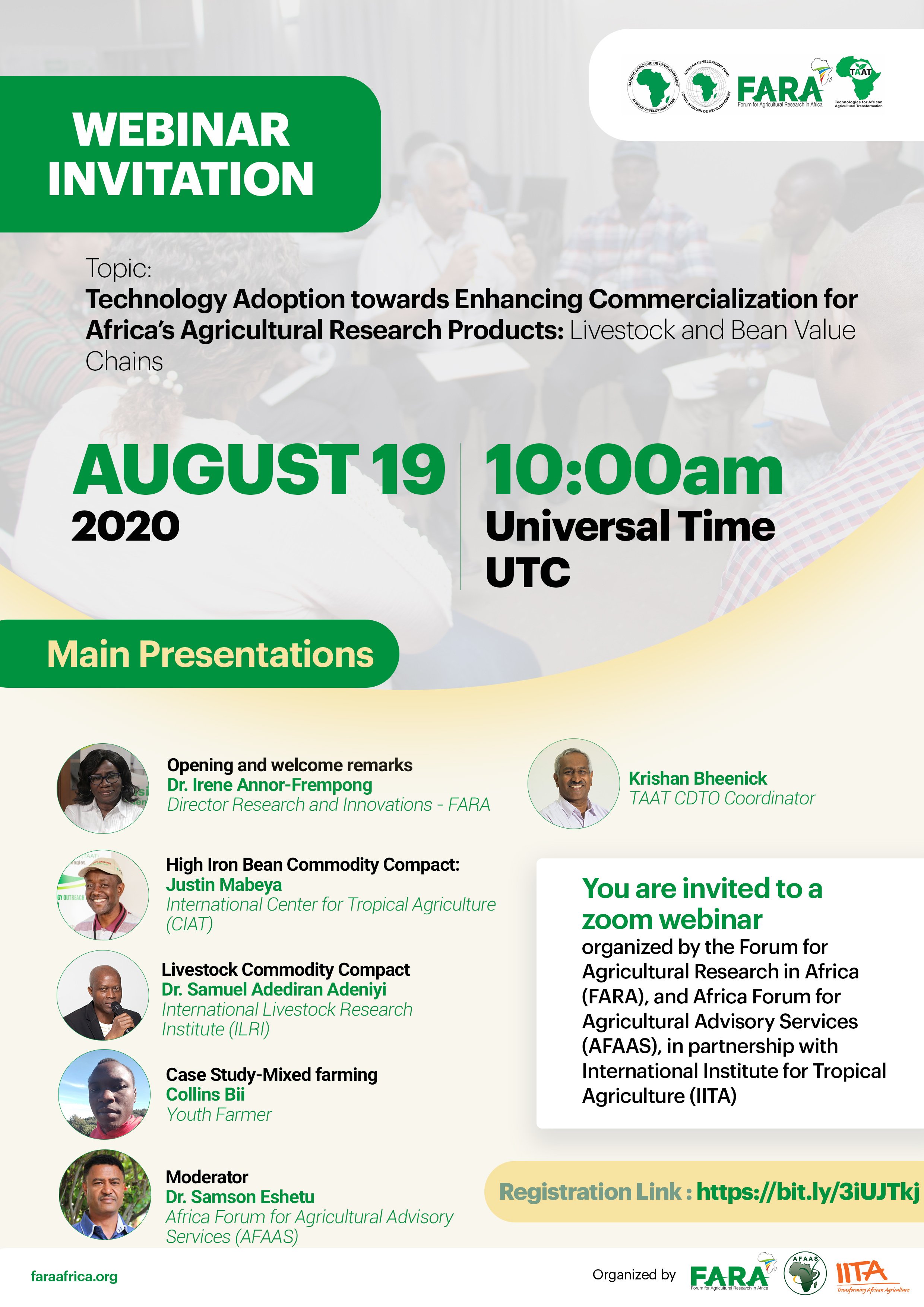
WEBINAR: Enhancing Commercialization of Africa’s Agricultural Research Products_Livestock & High Iron Bean
- How can we translate Africa’s agricultural research into products for commercialization?
- Can a market systems approach lead to rapid technology adoption by the end users?
- What are the agri-preneurship opportunities within the TAAT value chains that can trigger industrialization?
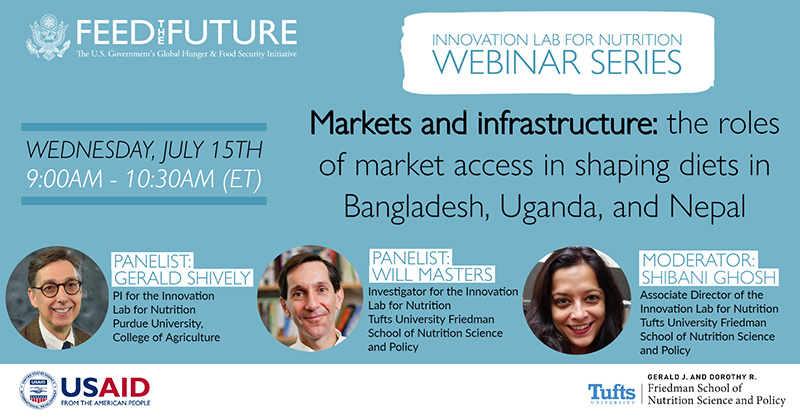
WEBINARS Feed the Future Innovation Lab for Nutrition
Designed to inform and engage stakeholders, this series covers research conducted by the Innovation Lab for Nutrition and its stakeholders over the past ten years. During each webinar, panelists present findings from their research, discuss policy implications of these findings, discuss what needs to be done to better link research to practice, and identify research gaps for future consideration.
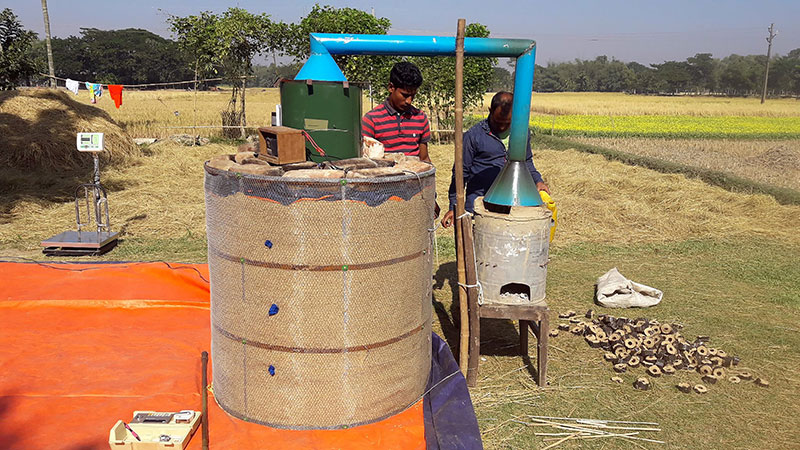
In Bangladesh, the Feed the Future Innovation Lab for Nutrition's focus is on aquaculture programming, linked in various ways to horticulture promotion, innovations in drying and storage of products, and behavior change communication. Located in the Feed the Future zone of Bangladesh (the South-West), NIL works closely with local academic institutions, international partners (such as IFPRI), and implementing organizations (such as SPRING) to generate strong empirical evidence of how food choices are made, how diets change, and what impacts are possible on nutrition.
This webinar covers NIL's research, findings, and innovative technologies in the realm of aquaculture and horticulture in Bangladesh. Speakers explain how their efforts contribute to a shared research agenda that ultimately informs policy and programming within the context of USAID and globally.
Many factors combine to shape diets and maternal and child health. In this webinar co-hosted by USAID Advancing Nutrition and the Feed the Future Innovation Lab for Nutrition, we review recent research from the Feed the Future Innovation Lab for Nutrition regarding the role of markets and infrastructure in mitigating nutritional risks. We focus specific attention on findings from Bangladesh, Nepal and Uganda, examining correlates and drivers of dietary diversity, linear growth and weight gain, and nutritional resilience.
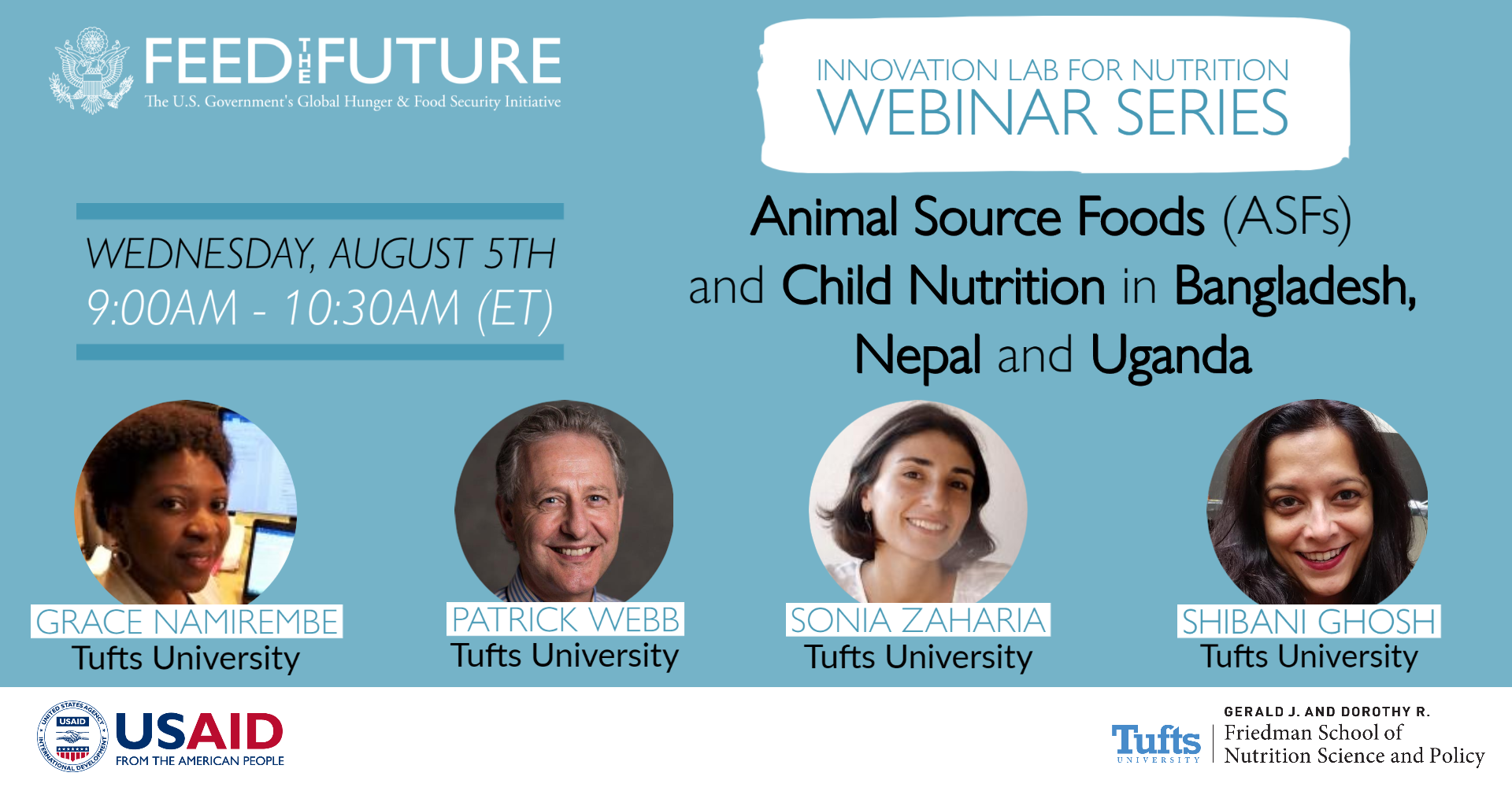
5 August 2020. Animal Source Foods (ASFs) and Child Nutrition in Bangladesh, Nepal and Uganda
Animal sourced foods (ASFs) are nutrient dense foods that when consumed in small amounts provide quality protein, vitamins, minerals and amino acids, and all nutrients critical for growth and development, particularly of infants and young children. While evidence supports the contribution of ASFs in improving the linear growth of children, a better understanding of the long-term effects of the consumption of different ASFs is needed.
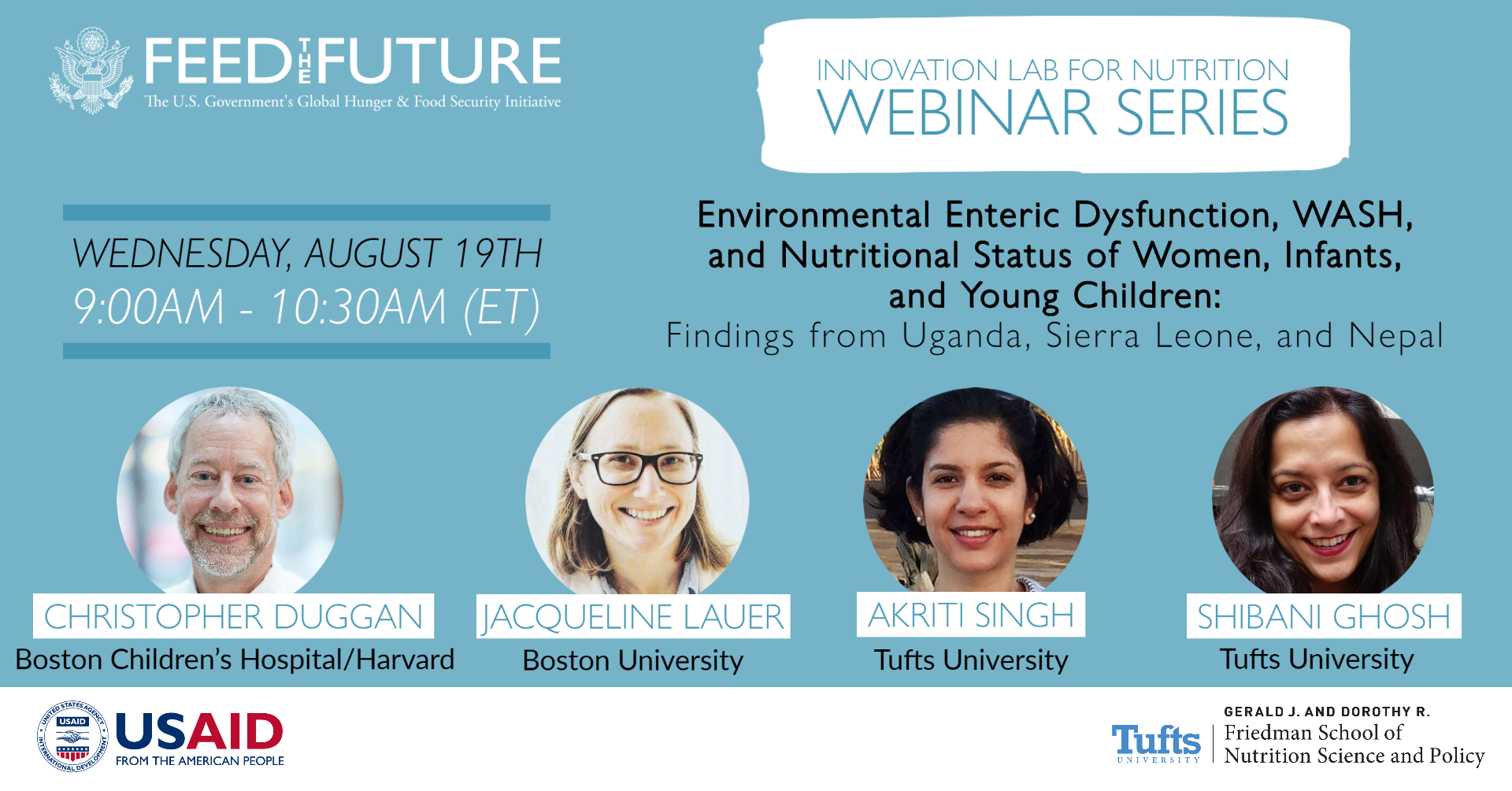
- It is associated with poor environmental hygiene and contamination, poor water quality, poor hygiene and sanitation practices, and an altered microbiota. EED has been implicated in increasing the risk of stunting and wasting in early life and the risk of a poor birth prognosis in pregnancy. However the evidence on both its causes and effects has been mixed.
- This may be in part due to measurement challenges as the gold standard metric of EED, the lactulose-mannitol test, measures only part of the EED process.
- Research supported by the Feed the Future Innovation Lab for Nutrition in Uganda, Sierra Leone, and Nepal aimed to test new metrics for EED assessment, examine the relationship of EED, stunting and wasting within the context of poor WASH practices, an altered microbiota, and the presence of contaminants such as mycotoxins.
- Dr. Shibani Ghosh - Research Associate Professor at Friedman School of Nutrition Science and Policy
- Dr. Jaqueline Lauer - Public health nutritionist and Clinical Assistant Professor at Boston University
- Dr. Akriti Singh - In August, Dr. Singh successfully completed her thesis defense to receive her PhD from Tufts University, Friedman School of Nutrition Science and Policy
- Dr. Christopher Duggan - Pediatric gastroenterologist and nutrition physician at Boston Children's Hospital, Professor of Pediatrics at Harvard Medical School, and Professor at the Harvard TH Chan School of Public Health
WEBINAR: Safeguarding Progress Towards Improved Nutrition During the COVID-19 Pandemic
- Food Systems Programming (p.6): Promote commercial production and support market measures for safe and nutritious foods; maintain local production of nutrient dense foods.
- Health Systems Programming (p.7-9): Promote and protect breastfeeding; complementary feeding; vitamin A supplementation (VAS); management of wasting and acute malnutrition; maternal nutrition counseling and supplementation.
- Humanitarian Assistance and Safety Net Programming (p.9-10): Continue to provide essential health and nutrition services while reducing direct contact with beneficiaries; safeguard social protection programs with an increased focus on supporting access to nutritious foods and nutrition services.
WEBINAR: Engaging youth and the private sector in extension and agricultural advisory
Due to the COVID-19 pandemic the event, originally planned for April 21-22, 2020 was rescheduled and will now be held virtually in several webinar sessions during August - September 2020. See below for more details.
To interrogate the state of extension systems in East Africa and devise mechanisms to take advantage of existing opportunities, the Feed the Future Developing Local Extension Capacity (DLEC) Project in collaboration with the African Forum for Agricultural Advisory Services (AFAAS), Eastern Africa Field Schools Support Hub and Forum for Agricultural Advisory Services – Kenya (KeFAAS) are organizing an online community of practice event on ‘Engaging youth and the private sector in extension and agricultural advisory services.’ The event will bring together experts, practitioners, researchers and funding partners to share, discuss and learn about issues of extension and advisory services in East Africa. The key messages and lessons will be documented into policy briefs that will be shared with East Africa policymakers to inform the extension policy agenda.
See full event concept note for more details.
Webinar session 1: August 5, 03:00 PM (Nairobi)
Role of private sector and youth in propelling digital disruption for invigorating extension and advisory services
Webinar recording (presentations):
Q&A session:
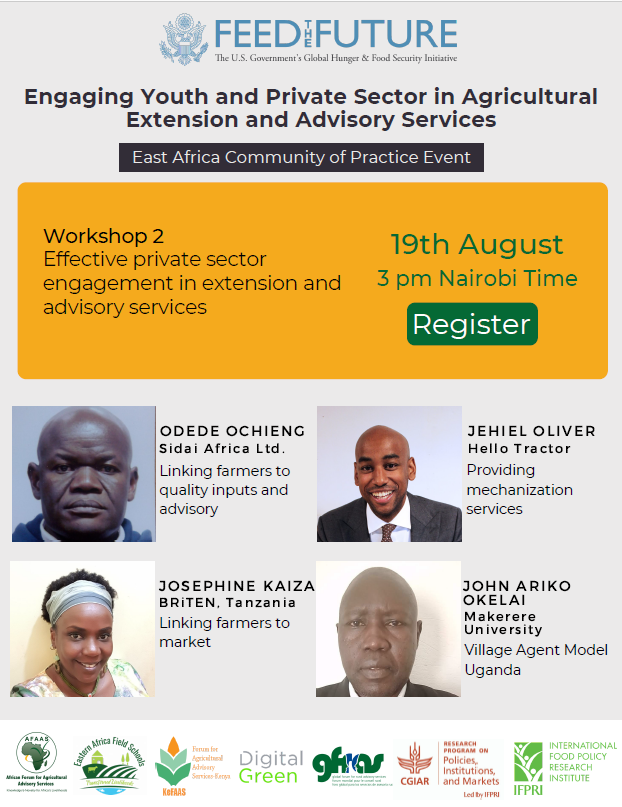
Webinar session 2: August 19, 2020 03:00 PM (Nairobi)
Effective private sector engagement in extension and advisory services
- George Chemining’wa, Chairman, KeFAAS
- Silim Mohammed Nahdy, Partnerships, Executive Director, AFAAS.
- Kristin Davis, Senior Research Fellow, Development Strategy and Governance Division, IFPRI and Project Co-Director, DLEC
- Linking farmers to quality inputs and advisory - Odede Ochieng, Sidai
- Providing mechanization services Jehiel Oliver, Founder and CEO, Hello Tractor
- Linking farmers to market Josephine Miingi, Founder and CEO, Building Rural Incomes Through Entrepreneurship (BRiTEN)
- Village Agent Model in Uganda John Ariko Okelai, Lecturer, Makerere University Business School, Agribusiness Consultant and Researcher
Webinar session 3: August 26, 2020 03:00 PM (Nairobi)
Topic: Gainful youth participation in extension and advisory services
Register
Webinar session 4: Sep 2, 2020 03:00 PM (Nairobi)
Topic: Double benefits for youth and private actor participation in scaling up successful extension approaches: Opportunities and challenges
Register
Wednesday, August 19, 2020
WEBINAR: COVID-19: The role of the agriculture-ecosystem health interface
Efforts to improve food security and nutrition have contributed to dramatic declines in forest and other natural ecosystems and rapid increases in contact rates between human and wild and domestic animals. Since 1940, agricultural drivers were associated with more than one quarter of all infectious diseases—and more than half of all zoonotic infectious diseases—that emerged in humans. Current risks of infectious diseases are particularly high in Asia, but projections suggest that infectious disease risk will grow fastest in Africa south of the Sahara, as crop area and livestock populations expand.
This policy seminar will discuss the agriculture-ecosystem health interface that was magnified by COVID-19, and will consider cross-sectoral solutions that could reduce such risk and enhance human and ecosystem health with a focus on the contributions that One CGIAR can make.
Speakers
- John E. Fa, Senior Research Associate at CIFOR and Professor of Biodiversity and Human Development at Manchester Metropolitan University
- Katharine Kreis, Director of Strategic Initiatives and Lead for Nutrition Innovation, PATH & Bridge Collaborative Secretariat Member
- Ricky Robertson, Research Fellow, IFPRI
- Christian Walzer, Executive Director of Wildlife Health, Wildlife Conservation Society
- Josh Goldstein, Director, Bridge Collaborative, The Nature Conservancy (TNC)
- Izabella Koziell, Program Director, CGIAR Research Program on Water, Land and Ecosystems (WLE)
- Eva Ohlsson, Senior Research Advisor, Swedish International Development Cooperation Agency (SIDA)
- Claudia Ringler, Deputy Division Director, Environment and Production Technology Division, IFPRI; CGIAR Research Program on Water, Land and Ecosystem Flagship co-lead and Bridge Collaborative Secretariat member


Caleb Olanipekun, World Vegetable Center
Moderator